Origin of the name Huydecoper, parents, mayor, construction of the country estate and brief overview of owners and tenants of the “De Brink” country estate
Origin of the name Huydecoper
The name Huydecoper represents a 15th-century Amsterdam family of mayors and patricians. Various members held administrative positions as directors of the Dutch East India Company (VOC) and West India Company (WIC), the Admiralty, and the State. However, it begins with extensive merchant activities, and the various families who married into the family all share a history of trade. In 1814, Jan Willem Huydecoper was appointed to the Knighthood of Holland, thereby placing him and his descendants among the young Dutch nobility.
The name Huydecoper is derived from an old profession. In the Middle Ages, surnames were often based on a person's profession or position. Therefore, the name Huydecoper refers to the trade of "hide merchant" or "leather trader." This profession was of great importance at the time. Leather was one of the most widely used materials for clothing, shoes, saddles, and other everyday objects.
Huydecoper Parents
Willem Karel's parents were the then owners and residents (1830-1867) of Zeist Castle. Jhr. Jan Elias Huydecoper (1798-1865) tot Maarsseveen, Lord of the Manor of Zeyst, married in 1820 to Marie Isabella Anne Josina Charlotte Baroness Taets van Amerongen (1802-1859). The couple had five sons: Joan (1821-1890), Jan Louis Reinier (1822-1909), Willem Lodewijk Johan (1824-1826), Karel Jan Frederik (1828-1829), Willem Karel (1828-1882) and four daughters: Henriëtte Jacqueline Wilhelmine (1836-1901), Sophia Adriana Johanna (1832-1904), Louisa Johanna (1832-1864) and Maria Isabella Anna Charlotte (1835-1919).
Mayor Willem Karel Huydecoper
Willem Karel, the fifth son, was mayor of Zeist from 1863 until his death in 1882. He married Johanna Maria Elisabeth Dijckmeester (1831-1904) in 1854 and had three daughters with her, the eldest of whom, Catherine Elize Wiggerdine (1855-1941), symbolically laid the foundation stone of the house on May 24, 1856. The other two daughters were Marie Isabelle Anne Josine Charlotte (1860-1949) and Elisabeth Willemina (1875-1944). After the death of the Jonkheer, his wife and later their daughter Elisabeth Willemina lived in the house until 1920.
Construction of the country estate
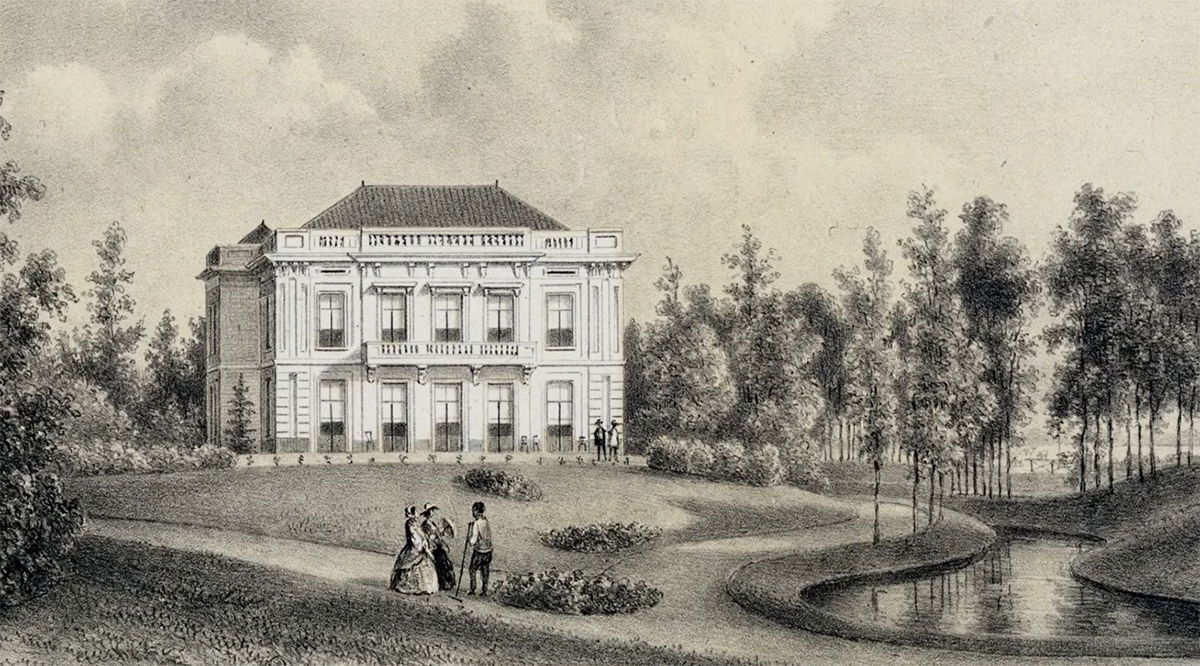
The country estate, laid out with a formal garden and oak forest, was self-sufficient with the help of a farm (1867), meadows, a vegetable garden, and an orchard. The house and landscape park were designed by Samuel A. van Lunteren (1813-1877), originally from Utrecht. First, the serpentine pond or winding pond was excavated at the front and side of the house. The excavated soil from the pond was needed to create a slightly raised hill on which the house was to stand. To enhance their prestige, many wealthy people at that time had their houses built on an artificially created hill. At that time, the pond filled itself through rising water (seepage water) bubbling up from the ground. This seepage water was so clean that it was pumped up in the cellar of the house for drinking water and domestic use. The second driveway on Kroostweg, opposite Brinkweg, served as a kind of entrance for staff and suppliers. To the right of this entrance lie a number of workers' houses where the domestic staff lived after the country estate was sold to the Van Beuningen family.
Brief overview of owners and tenants of the “De Brink” country estate
Park now 9 ha (was 20 ha)
- 1856 Owner: Jhr. Willem Karel Huydecoper (1830-1882) until his death. Married in 1854 to Johanna Maria Elisabeth Dijckmeester (1831-1904)
- 1867 Construction of farmhouse with meadows, orchards, and vegetable garden
- 1882 Owner: Johanna Maria Elisabeth Dijckmeester, widow of Jhr. Willem Karel Huydecoper, until her death
- 1891 Sale of farmhouse to farmer A. Westeneng. In 1959, the farm was still fully operational: There were meadows, hayfields, an orchard, and a vegetable garden. The livestock consisted of 2 horses and a foal, 9 pigs, 4 heifers, 6 calves, 54 turkeys, and 13 cows.
- 1904 Owner: Jkvr. Catherine Elize Wiggerdine (1855-1941)
- 1920 Owner: John Wells van Beuningen (1880-1967) until his death in 1967. Married in 1909 to Maria Magdalena Hartevelt (1888-1920). John was a director at the Coal Trading Association (SHV), founded by his ancestors and the ancestors of John Arthur (1939-2025) Fentener van Vlissingen.
- 1967 Owner: Heirs Mary Ramsden-van Beuningen (1914-2010) & John Wells van Beuningen (1917-1971)
- 1969 Owner: The municipality reaches an agreement with the Van Beuningen heirs regarding the purchase of the De Brink country estate and the pasture plot located behind it, on the condition that the landscape park remains open to the public. The land was needed for the construction of Zeist-West, including the districts of Nijenheim, Couwenhoven, Brugakker, Crosestein, De Clomp, and the small residential area of De Brink.
- 1969 Sale of the coach house and a portion of the land to the neighbors at Buitenplaats Beeklust: the Association for the Promotion of Christian Upbringing and Education for Blind and Visually Impaired Children and Young People “Bartiméus”.
- 1970 Tenant: Land Improvement and Reclamation Company “Grontmij NV”
- 1971 The Municipality purchases the farm and pastures, totaling 8.4 hectares, under duress for f 390,000. The land was needed for the construction of Zeist-West.
- 1978 Owner: BAM Holding NV, Bataafse Aannemingsmaatschappij NV for f 1,000,000,000 including the underlying and surrounding land on leasehold for 75 years • 1989 Owner and leasehold buyout: The Noro Group of Compagnies, Utrechtseweg 67. Owner and founder John Arthur Fentener van Vlissingen
- 1990 Construction of a miniature river landscape on part of the former meadows.
- 1990 Tenant: Carré, Orban & Partners, International Management Consultants
- 2002 Owner: Maliebaan Management BV/ Boron Real Estate Holdings BV Utrechtseweg 67
- Founder A. Fentener van Vlissingen (1939-2025) married to Marine Michèle comtesse de Pourtalès (1941), with 15,000 employees worldwide
- In 1975, he founded his own company; BORON and BCD are market leaders in the global travel industry of business travel, real estate, venture capital, and philanthropy.
- With the centuries-old company Royal Delft, he contributed to the preservation of the cultural heritage of Delft Blue porcelain for future generations.
- 2007 Due to their pristine condition, the old Brink, the house De Brink with the park, the entrance gates, and the farm De Brink were designated as national monuments.
- 2007 Due to their state of preservation, the old Brink, the house De Brink with the park, the entrance gates, and the farm De Brink are designated as national monuments. The historical values are of national significance.