De Swaen Inn, now Local Victoria
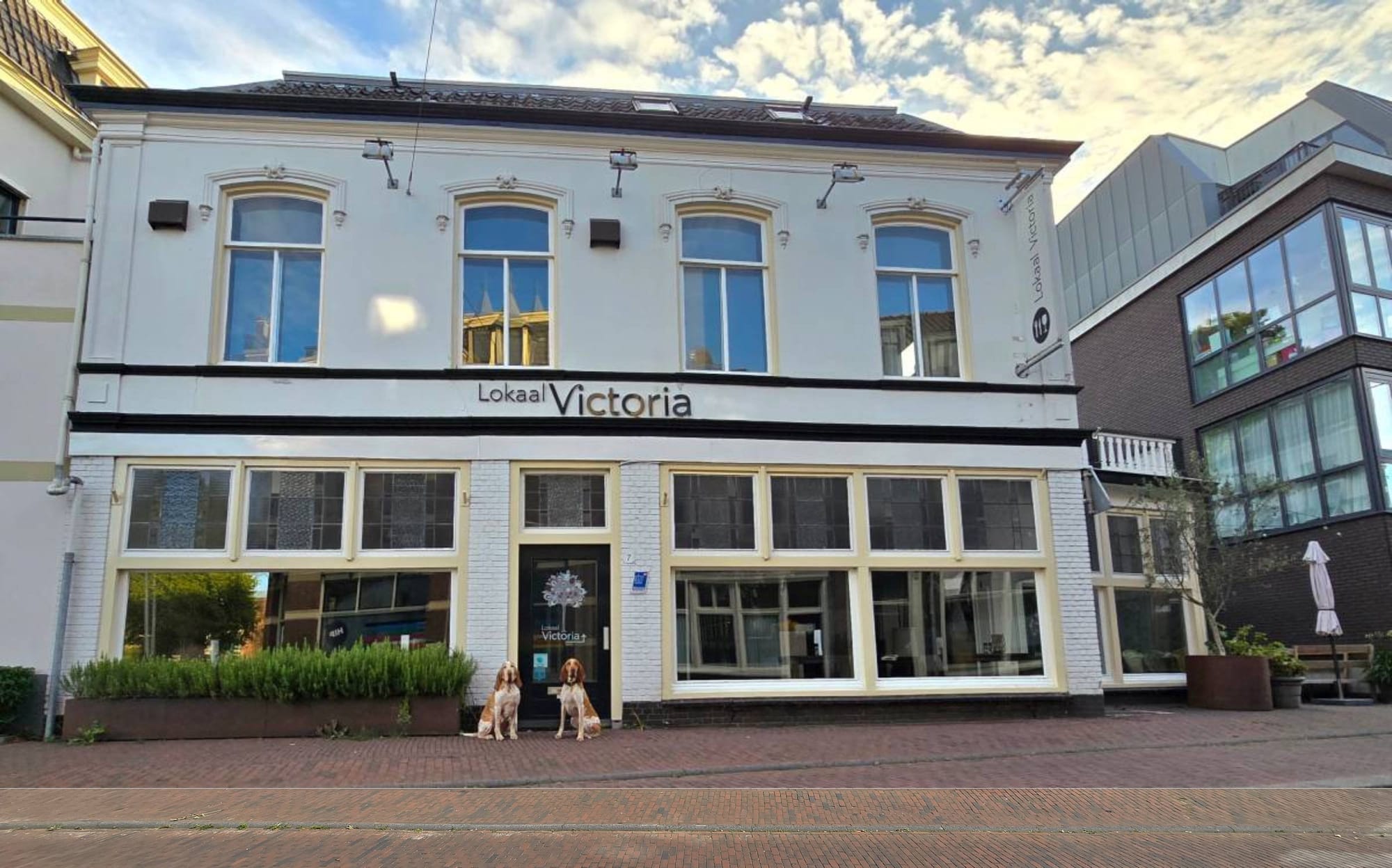
Jos and Matthijs and their wonderful team also warmly welcome us, along with our dogs Siena and Giulia (please report in advance), and treat us to delicious dishes paired with wines and beers. Besides over 30 tenants and subtenants, they are the 25th owners of this centuries-old establishment. Because I worked as a cook/waiter in a restaurant in Zeist for years during my school days, I almost always pop into the kitchen after dinner to thank the chefs for the delicious food. The kitchen team is invisible to the guests, and the waitstaff gets the compliments, but good food and good service are inseparable. Incidentally, the sunny terrace at the back of the restaurant, with its magnificent view of the Oude Kerk (Old Church), is a wonderful place to relax. I've known this establishment for fifty years, with its various owners and ever-changing interiors. We used to play billiards here, and I still remember a caged parrot named Jacco standing in front of the street-facing windows, greeting every customer. Curious about the restaurant's past, I thought, I have to find out and write a story about it.
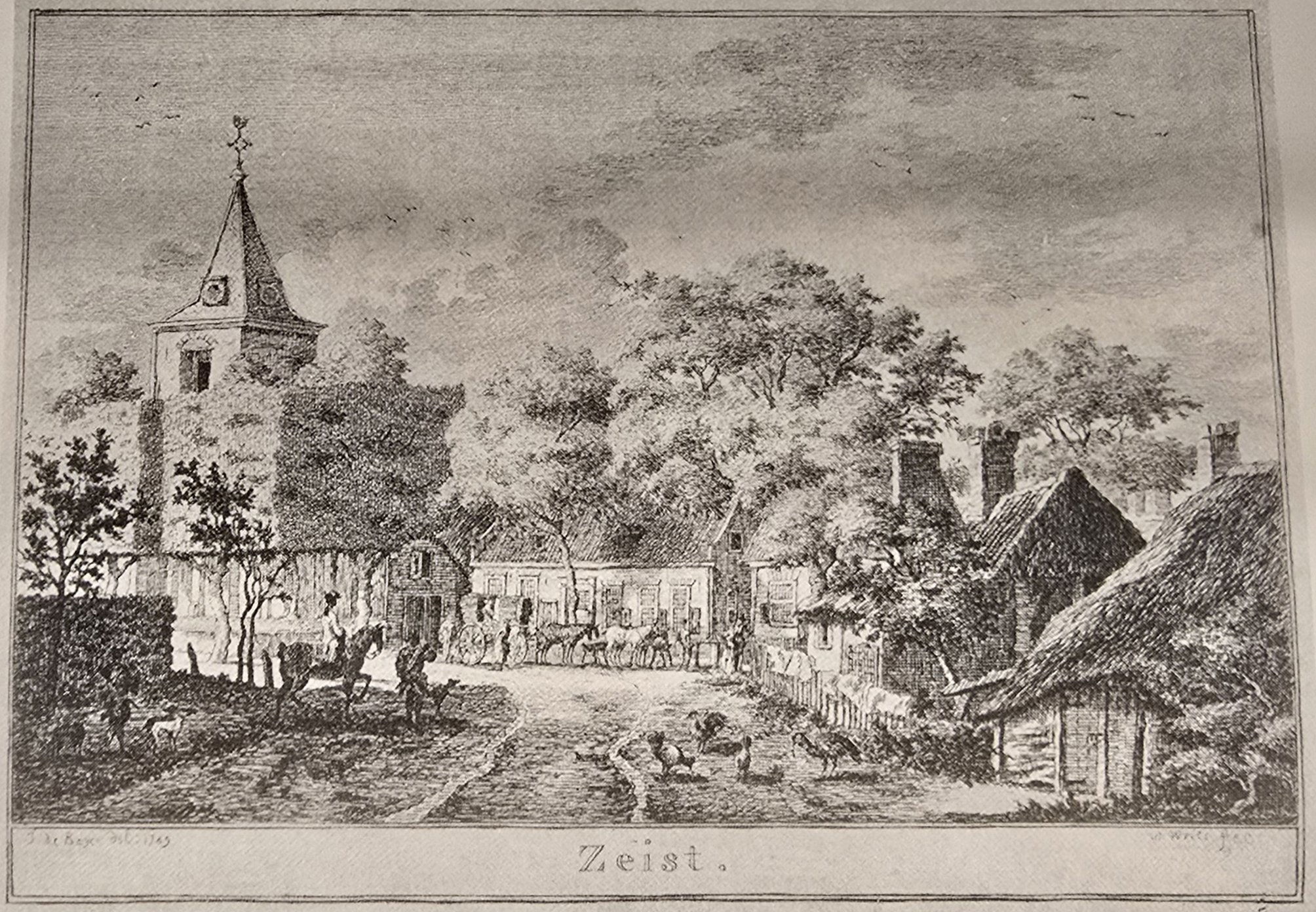
The history of the Victoria inn dates back to the late Middle Ages. Right next to the Old Reformed Church on Zeisterstraat, which was then the heart of our village, stood two inns. The church and the pub often stood side by side. The inn on the left, mentioned in 1515, was named "De Prins" in 1757. Around 1815, this name changed to "Het Hof van Holland," the name it now bears as an apartment building.
The Victoria inn on the right, with Gijsbert Willemsz Stael as owner-innkeeper, was slightly younger and was known around 1540 as the inn "De Swaen." Both inns, now designated municipal monuments, stood on land owned (leasehold) by the Lord of Zeyst, but the inn itself was owned by the innkeeper. In the pen drawing by Jan de Beijer in 1745, you can see the four-horse-drawn stagecoach or stagecoach in the front right, just barely a piece of the "De Swaen" inn.
According to writer Jacob van Lennep (1802-1866), the swan is a cheerful water animal that dives deep into the water with its long neck and is therefore the best symbol for a drinking house.
Dorpsstraat
But first, a few words about Dorpsstraat, the village of Zeist. It was also known as Zeysterstraat in earlier times and was located on the main road from Utrecht to Arnhem. It is one of Zeist's oldest roads and was officially designated as 1st and 2nd Dorpsstraat for the first time on April 24, 1895. A charter dated May 27, 1368, already referred to it as the "Strata de Zeyst," and another charter dated October 7, 1403, referred to it as "the good one, called Zeysterstrate." In 1816, the first and longest-serving mayor (1811-1850) of Zeist and also a large landowner, Frans Nicolaas van Bern (1786-1851), had Zeysterstraat paved with bricks. It ran roughly from where Huize Vollenhove now stands to De Swaen Inn, now Lokaal Victoria, in 1st Dorpsstraat. In 1851, the Dorpsstraat ran from the Van Reenenweg all the way to the corner of Molenweg.
Zeist's oldest restaurant
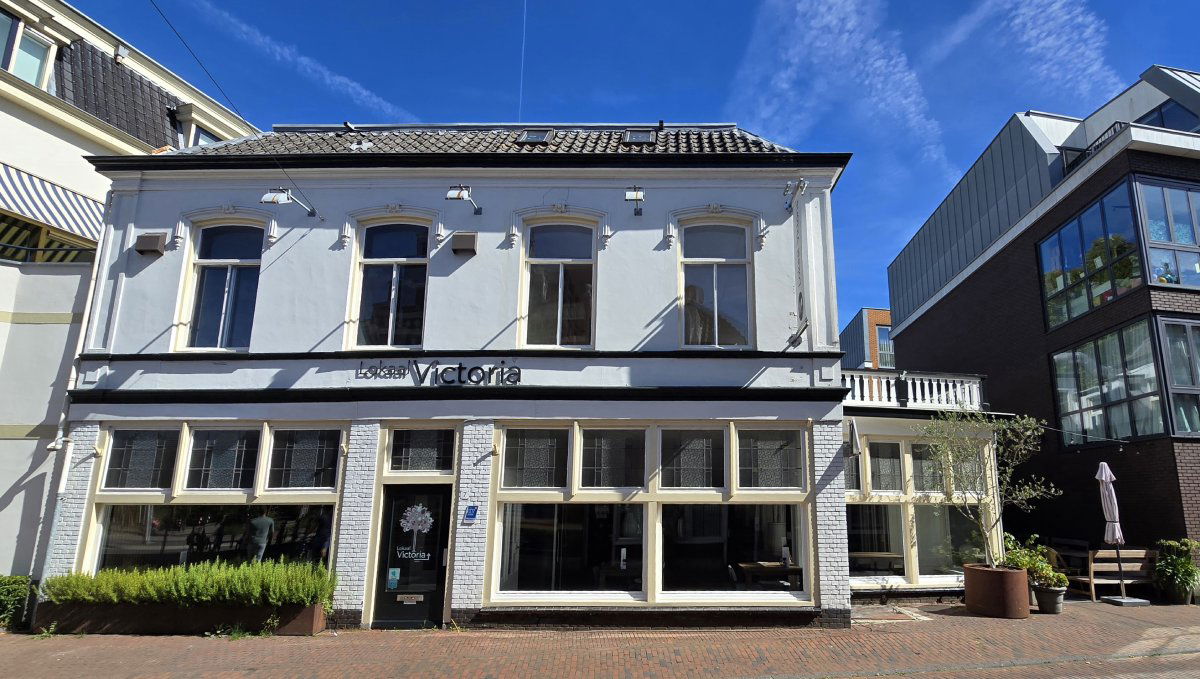
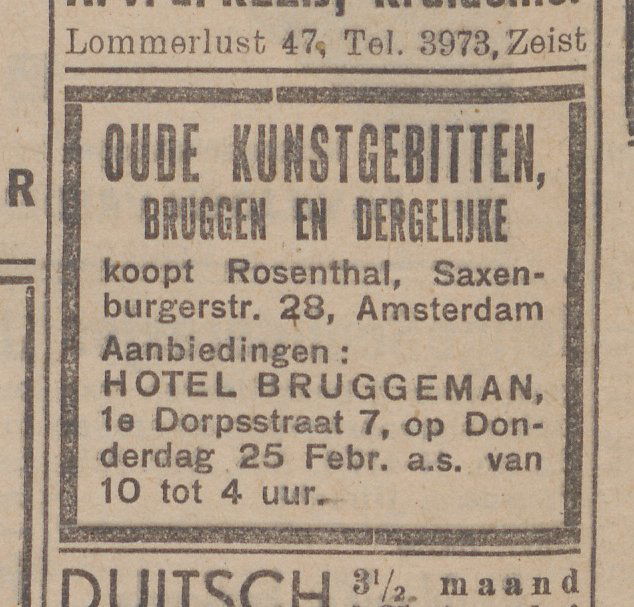
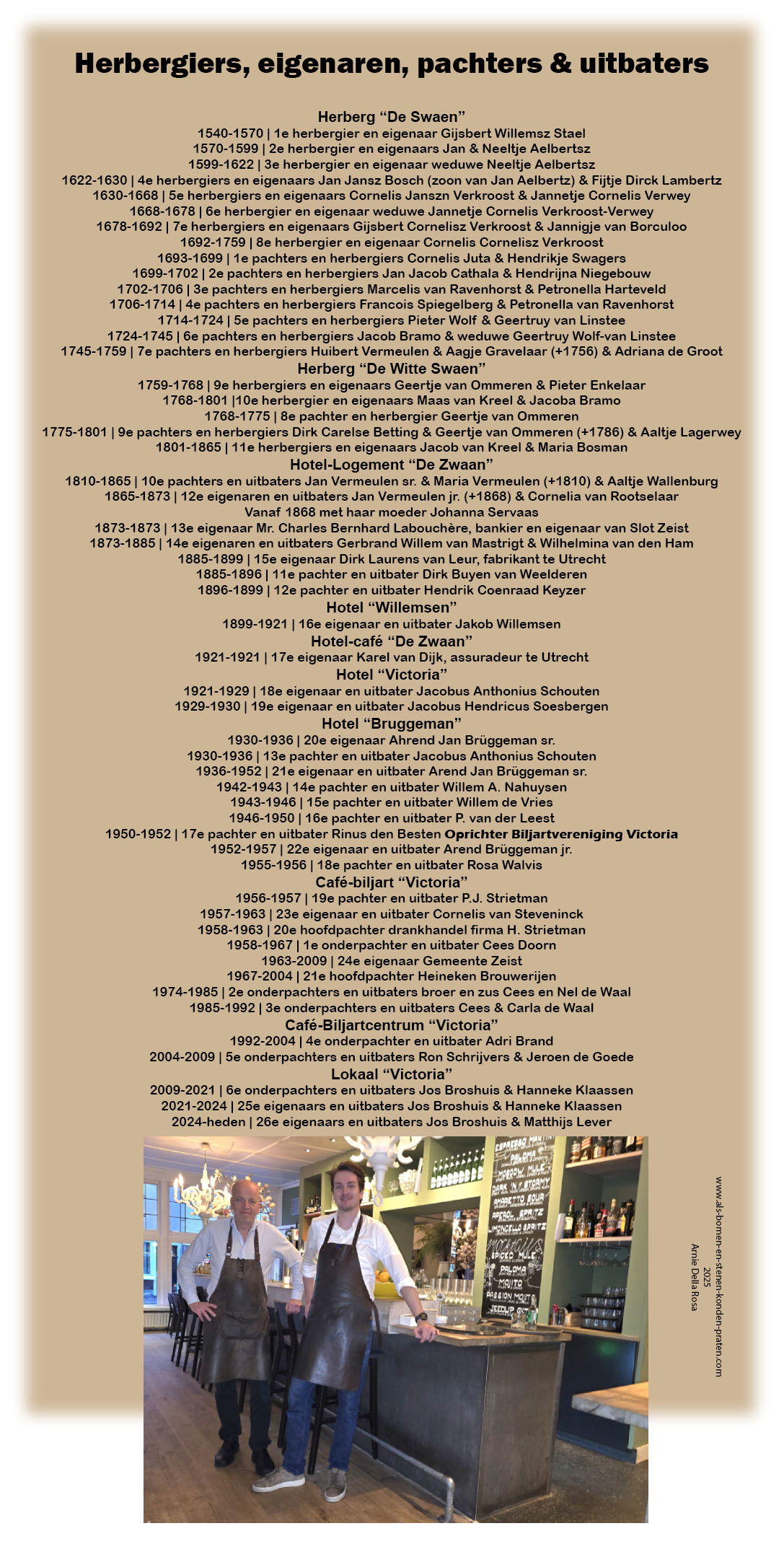
Lokaal Victoria is Zeist's oldest restaurant, and just as everything changes over the centuries, the name, functions, owners, and tenants of this establishment have also changed countless times. The name of this establishment hasn't been consistently the same over the years. It was sometimes called "De Swaen" (The Swan), then "De Witte Swaen" (The White Swan) in 1759, "De Zwaan" (The Swan) in 1816, alternating with "De Witte Zwaan," and then again "De Swaen." From 1900 onward, it was no longer referred to as a lodging house but as a hotel. First "Hotel De Swaen," in 1900 "Hotel Willemsen," 1910 "Hotel De Zwaan," 1920 "Hotel Victoria," 1923 "Hotel de Zwaan," 1930 "Hotel Bruggeman," in 1955 again "Hotel Victoria," in 1998 "Café Biljartcentrum Victoria," and since 2009 "Lokaal Victoria." The interchangeable use of terms like inn, lodging, café, restaurant, hotel, pension, billiard center, and now "local" was very confusing during the research and writing of this story. For example, the innkeeper was also called "lodge owner," "café owner," "restaurant owner," "hotel owner," "manager," and "owner," "tenant," or "subtenant." The single, most important thing that remained unchanged throughout all these years was that this establishment remained a welcoming meeting place or living room to this day, where villagers met and enjoyed food and drinks. Victoria has seen turbulent times with many events, renovations, demolition, and new construction in 1896, and changing functions, but it still stands firmly atop its still-used medieval cellar with its tiled floor. If you visit Lokaal Victoria and look closely in the rear room on 1st Dorpsstraat, you'll see the hatch to the left of the original entrance leading to this cellar, above which stood the common room of the former inn. Over the past five centuries, the establishment has had 25 owners, 22 tenants, and 5 subtenants (see the chapter "Owners, Tenants, and Subtenants"). It should be noted that there is a gap with unknown tenants from 1974 to 1998. If you know the names of these subtenants, please let me know.
1865 Description: De Zwaan
The lodging house, called "De Zwaan," housed the lodging house, coffee house, and livery stable, with a large yard and stables for 40 horses; also a coach house, barns, yard, land, and vegetable garden, totaling 12 rods (120 m deep) and 70 ells (70 m wide), located in Zeijst on Dorpsstraat. In addition to the large common room, the house contains eight other rooms, a kitchen, a cellar, an attic, a loft, and clean furnishings, including tables, chairs, a billiard table, a bar, beds, linens, silverware, tavern utensils, and other movable property. Furthermore, there are horses, carriages, two omnibuses, farm wagons, horse harnesses, stable equipment, etc.
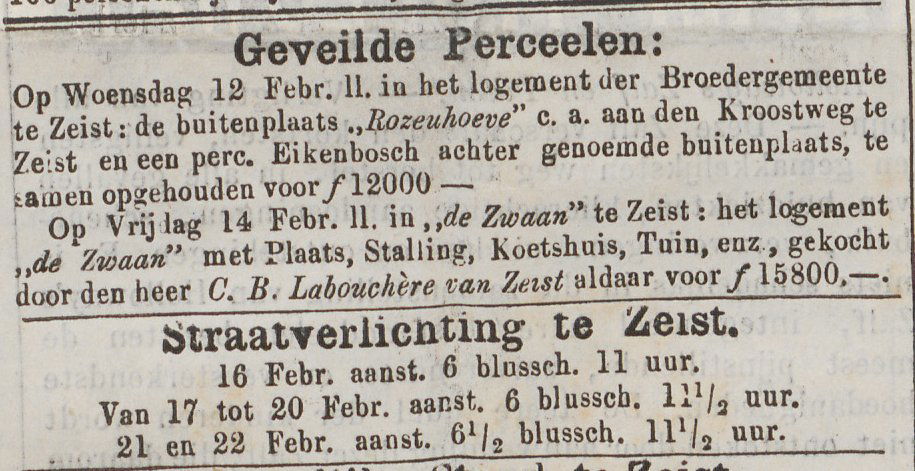
1873 Purchase and private resale (see the 1864-1944 Victoria advertisements in the photo gallery)
In 1873, Charles Bernhard Labouchère (1817-1897), owner of and resident at Slot Zeist, bought the property for 15,800 guilders, only to resell it less than a week later by private sale to Gerbrand Willem van Mastrigt, the head gardener at the "Ma Retraite" estate. This must have been Charles Labouchère's thinking, as the sale price was likely considerably higher than the 15,800 guilders he paid for it a week earlier. It's surprising, incidentally, that a head gardener could afford such a sum in those days.
Another clever move by Charles was that two days before the transfer on March 28th, he sold the entire contents, including furniture, beds, table linens, bed linens, and household goods. There were also two tent wagons, a char-à-banc (carriage), a blue-painted wagon, an eight-passenger omnibus (horse bus), a goods wagon, a farm cart, harnesses, a trolley, stable tools, some hay and straw, and four horses that walked well along the road. Gerbrand Willem van Mastrigt must have felt cheated, because without these household goods and equipment, he couldn't run his business here, and so he spent quite a few guilders more.
Activities (see the 1864-1944 Victoria advertisements in the photo gallery)
The fact that the inn was truly the center of Zeist is evident from the long list of public sales and auctions, tenders, meetings, purchases, performances, and shows. Several stand out, such as the auction of the windmill "De Hoop," the lease of the Koppelsluis lock, the sale/auction of the De Zwaan lodging house, tree plot sales on the estates of Molenbosch, Wulperhorst, Hoog Beek en Royen, Schoonoord, Schaerweyder Bosschen, Rhijnwijk, and De Kleine Breul (now Nieuw Beerschoten), the establishment of a shooting club, portrait photography and photographing of country estates and landscapes, the sale of the vinegar factory De Ster and the soap factory De Balans, the tendering of the Zeist bathhouse, the sale of Midden-Hoeve and Zomerlust, a billiards competition by the Sociëteit de Gezelligheid, a meeting to reappoint mayor Gerrit Costerman, the Zeist Men's Choir, and the Zeist Ice Skating Club, a checkers simultaneous exhibition "Ons Genoegen," the auction of the villa "'t Witte Hek," the meeting of the Zeist Aquarium Club, St. Nicholas' Day celebrations, and the NSDAP's Grosse Kundgebung (gathering). Sturmbannführer Dr. Linges, National Social Women's Organization, propaganda meeting and winter aid Netherlands, Dutch People's Service, public meeting of the Dutch Workers' Front members, theater performances in the back room, poetry evenings, and finally, a remarkable advertisement from 1943 concerning the purchase of old dentures, bridges, and the like. I can already picture the new owners with such ill-fitting secondhand dentures. Brrrrrrrrrrr
1834 Diligence/stagecoach
By 1834, the 2,681 residents of Zeist had 162 draft horses and 132 vehicles, including 13 carriages and 12 sjezen (light two-wheeled horse-drawn carts), at their disposal for travel and freight transport. From 1845 to 1879, they could also use the Van Gend en Loos stagecoach, the "Arnhemsche Wagen," which provided twice-weekly travel to Utrecht and back. The 12th owner and innkeeper of "De Zwaan," Jan Vermeulen, had a stable for 40 horses next to the alleyway adjacent to the inn since 1820, where stagecoach companies could refresh their horses. From 1844 onward, the inn served as the starting point for the omnibus service between Zeist and the Zeist-Driebergen station of the Dutch Rhine Railway, established that same year. From 1850 onward, Paul Dieges operated a stagecoach service with his stagecoach, three times a day, and by 1863, five times a day. It started from his house on Biltstraat in Utrecht (outside the Wittevrouwenpoort gate), went through Dorpsstraat in De Bilt, and ended at the "De Zwaan" lodging house on 1e Dorpsstraat in Zeist. The fare from Utrecht to Zeist was 35 cents, and the return day cost 60 cents. At that time, the Steenstraat, or Biltse Steenweg, was the trade route from the west of the Netherlands to Cologne, and because it was paved, it could be used by carts. In 1864, Dieges faced competition from the Van Wijk company in Zeist. The better-off traveled with Van Wijk, who laid hay on the floor in winter, and the less fortunate with Dieges. Due to the opening of the Utrecht-Zeist horse-drawn tram in 1879, Dieges and Van Wijk ceased passenger transport.
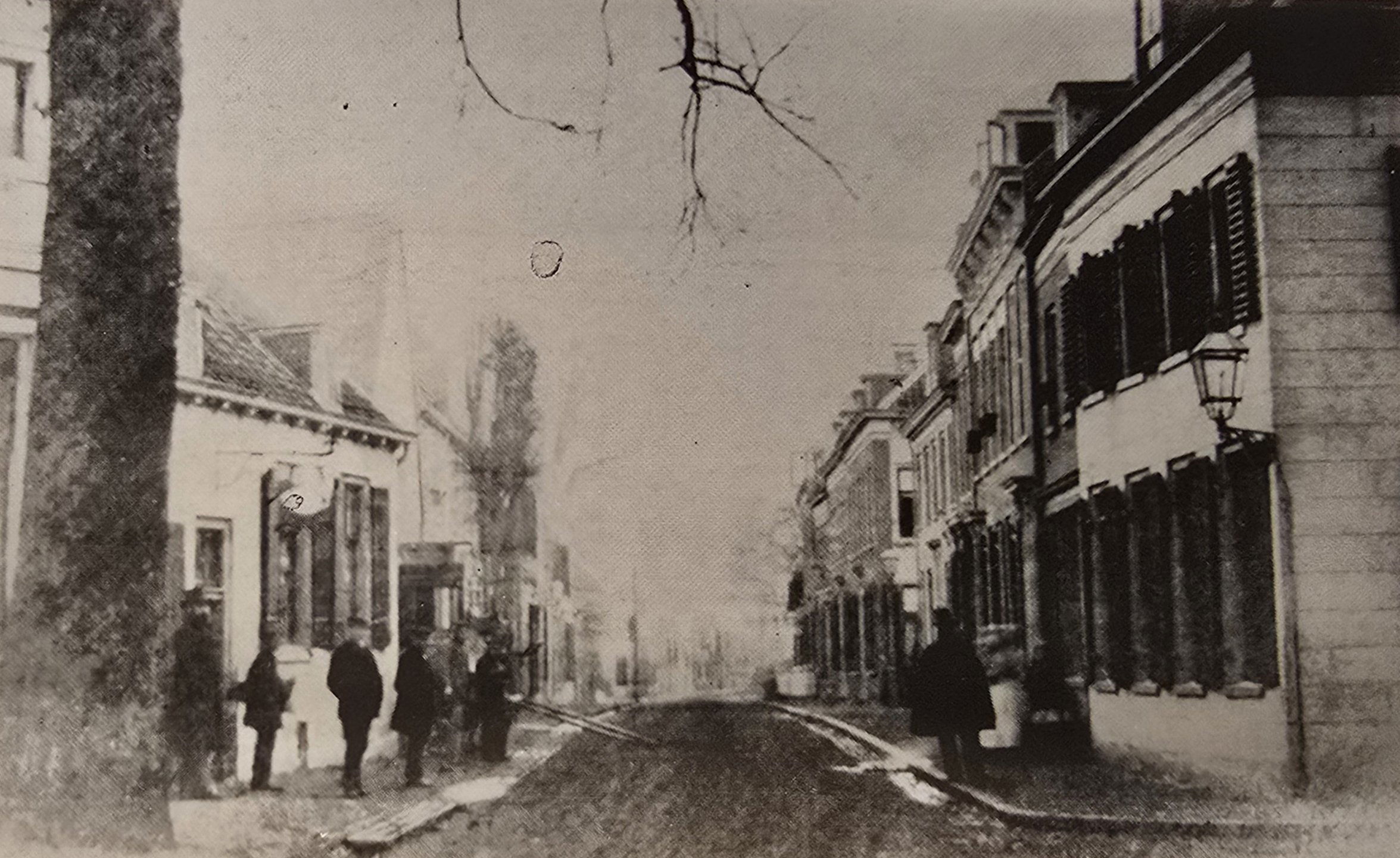
An advertisement dated May 10, 1873, shows that the 14th owner, Gerbrand Willem van Mastrigt, operated a passenger and freight service from "De Zwaan" Inn with his two horse-drawn buses between Zeist and Zeist-Driebergen Station. This service was in accordance with the timetable of the Utrecht-Arnhem line, opened by the Dutch Rhijnspoorweg in 1845. In the accompanying photo from 1880, you can see the omnibus, not yet harnessed to horses, parked in front of the stable, on the left, past the old inn. In 1886, A. van Wijk from Zeist took over these services with the Omnibus service for 9 people from "De Zwaan" Inn.
Renovations
At a public auction in 1873, the inn was listed as containing a spacious common room, seven downstairs and upstairs rooms, a kitchen, an attic, cellars, stables, a coach house, and barns. The oldest known photograph from 1880 shows that the inn was still a small building. To expand the inn, the stables for 40 horses and the coach house were moved to the rear of the garden in 1881. In addition to a living room, a dining room was added next to the common room, opening onto the veranda and garden (currently the conservatory). Three bedrooms were given their own fireplaces, and all seven bedrooms shared a bathroom, with three more rooms in the attic.
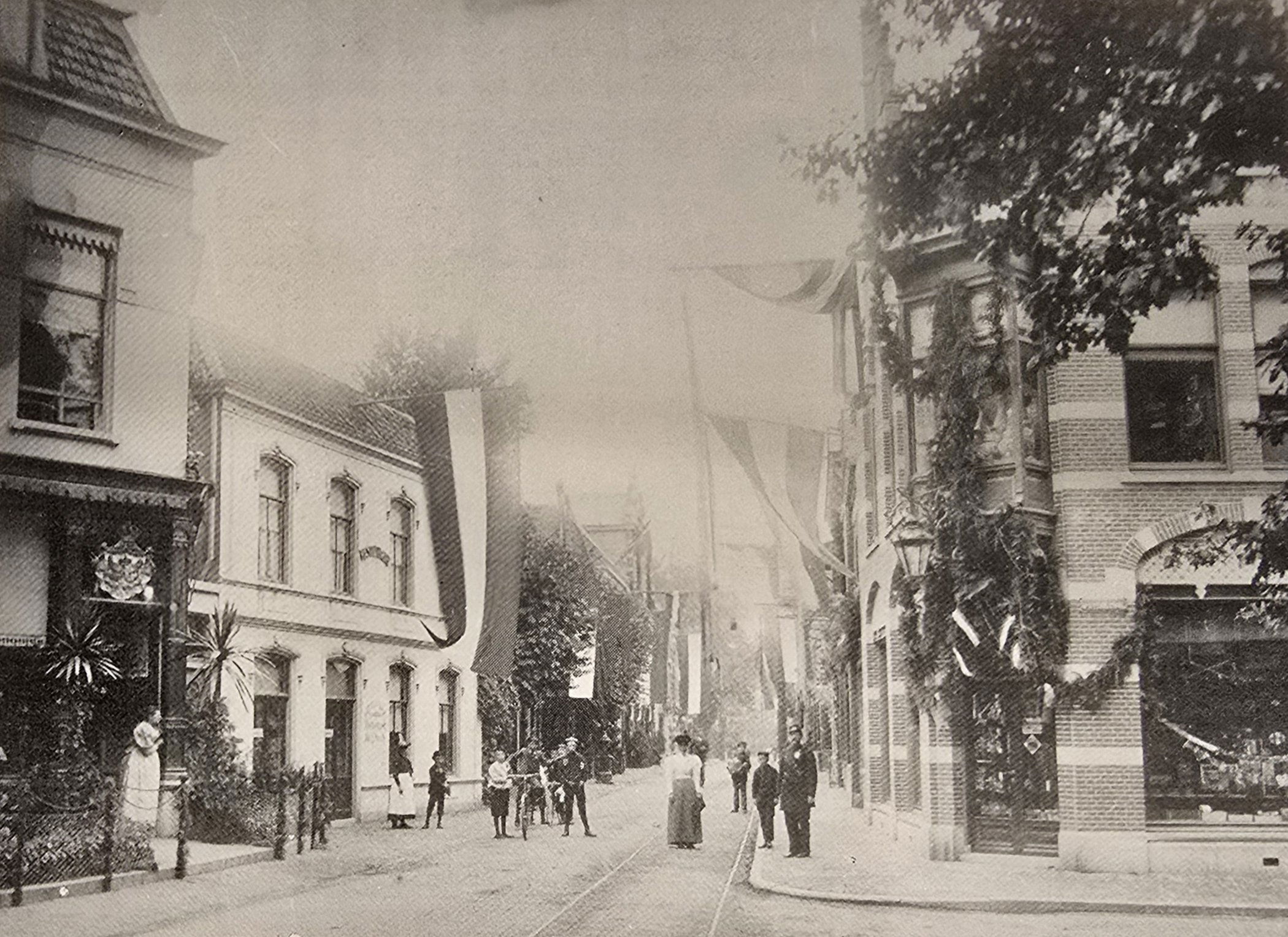
Photo: August 31, 1898 Inauguration of 18-year-old Wilhelmina - De Zwaan built in 1896
After the new construction in 1896, the inn acquired the appearance it still has today. Construction drawings from 1930 show the café, kitchen, meeting room, and another café room with a closed-off conservatory on the ground floor. Upstairs, there were six bedrooms, a bathroom, and a sitting room with a balcony. After the renovation in 1934, the café room on the left was converted into a meeting room, and by adding on the flat roof, a second meeting room and two additional bedrooms were added. A total of seven bedrooms with bathrooms were created. In 1935, a theater room with storage space and an upstairs apartment were added to the rear extension. After the renovation in 2000, Billiards Club Victoria had a spacious front and back room with three match tables (competition tables) and four small tables. After the removal of the porch at the old entrance and the modernization of the restrooms in 2009, there was one more major renovation. In 2015, a small room (20-40 people) with a bar was added to the rear next to the back room, or "the stable." This room provides access to the beautiful terrace overlooking the Old Church.
Billiards Club Victoria
An advertisement from 1865, concerning the public auction of "Logement Victoria," states that a billiard table already existed there at that time. The "de Gezelligheid" club organized a billiards competition (then spelled "Billard") there in 1886. Owner Rinus den Besten initiated the establishment of Billiards Club Victoria in 1950, and the first large match table was inaugurated in 1963 by 35-time world champion Raymond Ceulemans and Dutch billiards champion Cees van Oosterhout, owner of the billiards factory "Wilhelmina" De Pijp in Amsterdam. From 1965 onward, this renowned "Silver Billiards Tournament" was played thirty times. The challenge prize was a sterling silver billiard table made by a jeweler, and the first winner was Cees van Oosterhout. This tournament made Victoria world-famous in the Dutch billiards community, and every top player knew Victoria. Parrot Jacco made his debut as a mascot in the 1960s. I wonder, by the way, where he went after Victoria had to close due to rent increases in 2009, and the club, with over 60 members, was dissolved just before its 60th anniversary in 2010.
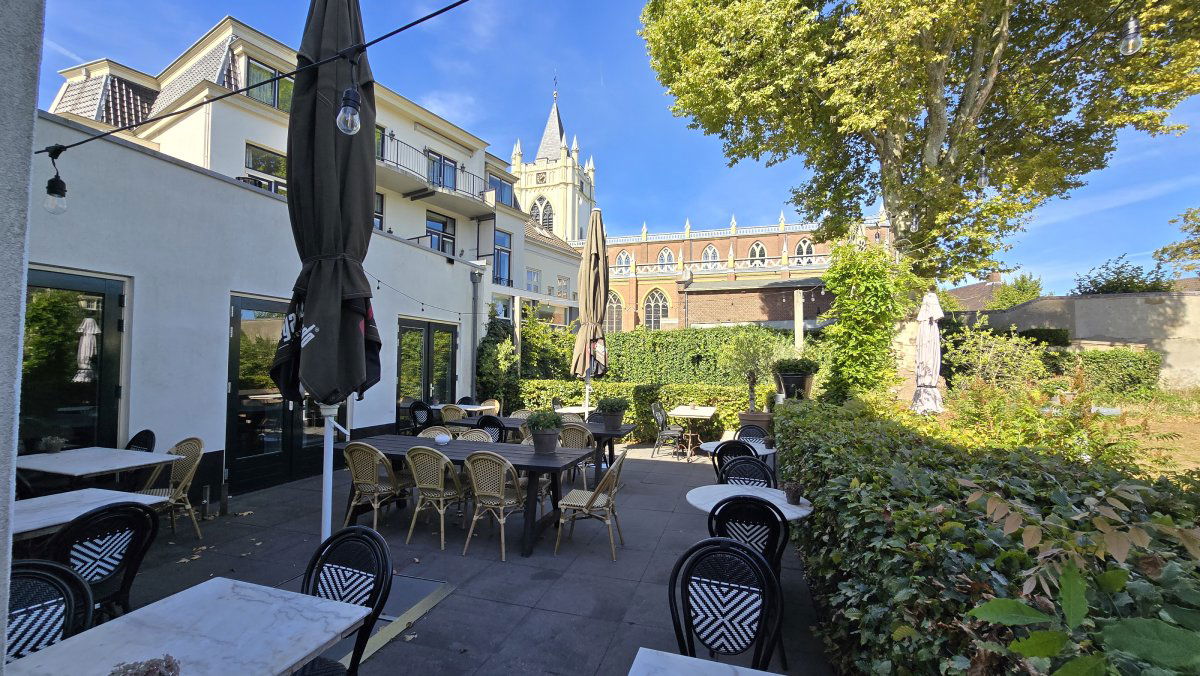
Current owner The municipality of Zeist acquired "Victoria" in 1963 because, due to future traffic development, it had plans to extend Waterigeweg to Kerkweg and widen 1st Dorpsstraat, which meant "Victoria" had to be demolished. Yes, the municipality of Zeist has always been good about demolition in our old village. Fortunately, the demolition of "Lokaal Victoria" and the other buildings on 1st Dorpsstraat did not go ahead, and we can continue to enjoy these old buildings and facades. Jos Broshuis and his wife Hanneke became the tenants of this building in 2009 after a thorough renovation of the kitchen and bathroom, now under the name "Lokaal Victoria." In 2021, Jos purchased the building from the municipality of Zeist, and since 2024, he and his partner Matthijs Lever have owned "Lokaal Victoria." This guarantees the continuation of this oldest catering establishment with almost five hundred years of hospitality in Zeist.
As the name of my website, "If Trees and Stones Could Talk," says, this nearly five-century-old centerpiece of our village could tell us a great deal about the history of Zeist.
Old and new photos, advertisements and more can be found in the photo gallery at https://www.als-bomen-en-stenen-konden-praten.com/galerij
Zeist is so beautiful, and we're so lucky to live here.
Arnie Della Rosa
Want to comment on a story? Please include your name and email address with your comment so I can respond if necessary. Don't want to miss anything and receive an automatic notification when a new story is published? Send an email to avanr1956@gmail.com and I'll add you to the mailinglist.
Sources and photos:
Many dates are likely/approximate, according to the sources: Zeist Historical Society, Van de Poll Foundation Zeist, Victoria, Municipal Archives, Memory of Zeist, Van de Poll Foundation Zeist (Foundation for the promotion and dissemination of knowledge about the history of Zeist), Utrecht Archives.
You can read my walking stories at https://www.als-bomen-en-stenen-konden-praten.com.