Unknown village square and country estate "De Brink"
Having lived in our beautiful village of Zeist for well over half a century, I find myself realizing that its beauty has become second nature to me. Only when you return from holidays abroad, or, as I have done, having worked in Zoetermeer and Almere for years, do you realize upon driving into Zeist how fortunate we are to live in this fine municipality with its forests, wide avenues, country houses, and villas. Zeist remains, after all, the village where I feel at home, and no, I have no affinity for the city. That is why, on holiday, we always stay in the countryside and in peace and quiet. You can always seek out the hustle and bustle for a day; the reverse is more difficult.
Traveling along the Utrechtseweg from De Bilt, you pass the five-century-old Vollenhove estate with that beautiful house. A little further on to the left is stable Den Eijk, and crossing the municipal boundary, you zigzag past country houses and villas with names like Blanda, Nuova, the Italian palazzo-style Ma Retraite, Veldheim, Lenteleven, Schaerweijde, De Brink, Bloemenheuvel, Beeklust, Stenia, Lommerlust, Arendsburg, Slot Zeist, and further on towards Driebergen follow Beek en Royen, Hoog Beek en Royen, Sparrenheuvel, Molenbosch, Groenoord, Noordbergh, Nieuw Beerschoten, De Breul, and then suddenly you are out of Zeist again. Behind this long, leafy ribbon of houses and estates, there is actually much more beauty to behold. But arriving in and through Zeist this way is truly beautiful, wouldn't you agree? In the past, my colleagues repeatedly asked me to come and live in Almere and did not understand my teasing remark with a serious undertone—"I wouldn't want to be caught dead here"—until they drove through Zeist to visit me and gazed in wonder at all this beauty. The Stichtse Lustwarande, of which Zeist is a part, numbered more than 100 country estates in the nineteenth century and stretched from De Bilt to Rhenen. In earlier times, it was a refuge for wealthy merchants and bankers who fled their polluted homes and cities in the summer and exchanged them for fresh air. Because land in Zeist was so cheap, but also because it was easily accessible, our village boasted no fewer than 67 country estates and manors. It is a pity that we are not more careful with our monuments here, for much has been demolished, but fortunately, much has also been preserved.
In the Newspaper of February 2nd of this year, I read that the number of inhabitants of Zeist has decreased over the past year for the first time since 2013. I heaved a sigh of relief and thought, fortunately, we remain a village. Yes, Zeist is an old people's municipality, with fewer births than deaths for 12 years in a row. In 1880, our municipality had only 5,965 inhabitants, which doubled in 1910 to 13,076 inhabitants, continued to grow to 66,671 in 2025, and is currently declining to 66,656 inhabitants.
Medieval town square
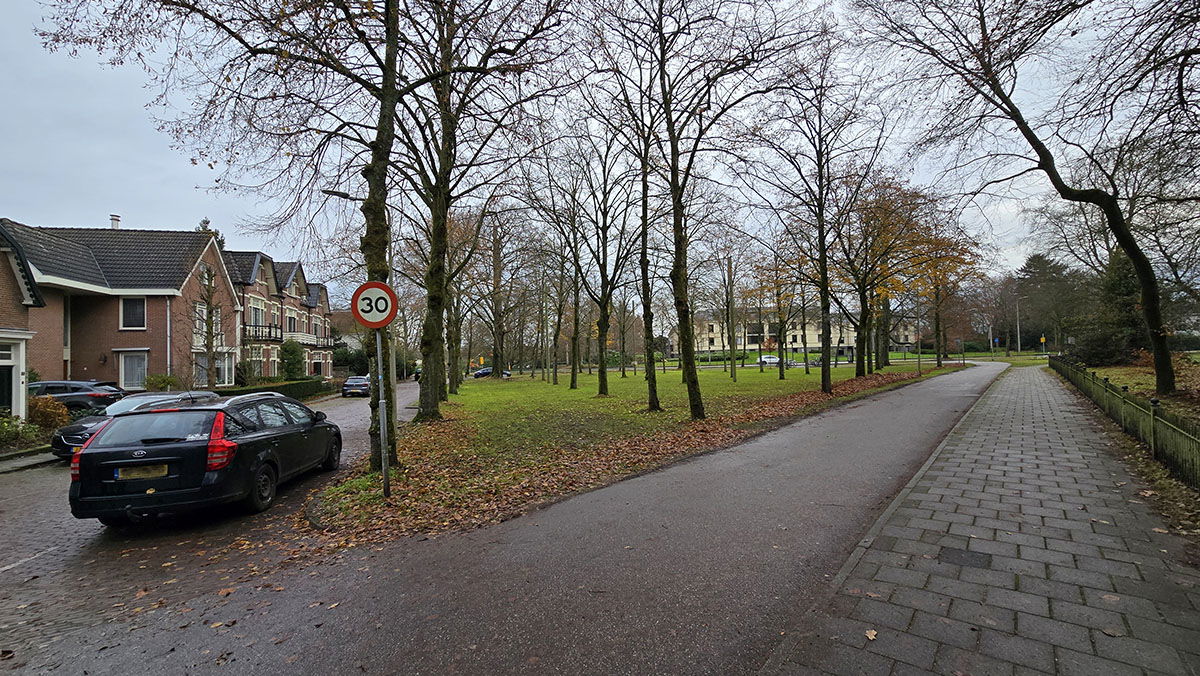
Every day, thousands of people drive and walk past the green triangle situated at the intersection of Utrechtseweg and Kroostweg, unaware that this medieval Brink is the oldest part and village square of Zeist. Daily life unfolded here; this was the meeting place for the inhabitants. A place with an important social and cultural function where livestock were herded together in an open space. Markets were held here, and village activities also took place. Here also stands an enormous, densely overgrown old beech tree in which a Little Owl nests every year. If only that tree could talk, what would it have to say?
Country Estate De Brink
The country house on the De Brink estate, situated at Utrechtseweg 82 and diagonally opposite Huize Schaerweijde, was built in 1856 commissioned by Jhr. Willem Karel Huydecoper. For the development of the estate, he purchased 20 hectares, or 2 square kilometers, of land including a homestead/farm from the widow of Everd van den Brink, Sophia Oortman. The former Hofstede den Brink referred to the village green located southwest of the estate, close to the 12th-century village church of Zeist. The tower of this 12th-century church has been preserved, but the nave and choir were replaced in 1841.
Incidentally, I am regularly surprised that when friends and acquaintances living in Zeist ask me what I am writing about at the moment, and I tell them about the country estate De Brink, where the mayor lived nearly two centuries ago, they do not know where it is located.
But now on our way
For over fifty years, I have walked with some regularity from all corners of Zeist to the De Brink country estate. First with our daughter, and later with granddaughters, to the petting zoo on the corner of Kroostweg and Griftlaan, before continuing on to the estate itself. Often with my partner, but always with our dogs. There were our blue roan Cocker Spaniel Joep, later his companions Charlie & Chaplin, and even later the German Wirehaired Pointer Claire, his Shorthair companion Joy, then with our Italian Bracchi Luna & Siena, and since 2022 with Siena & Giulia. Here, we have forged many friendships with other dog owners, but also shared joys and sorrows.
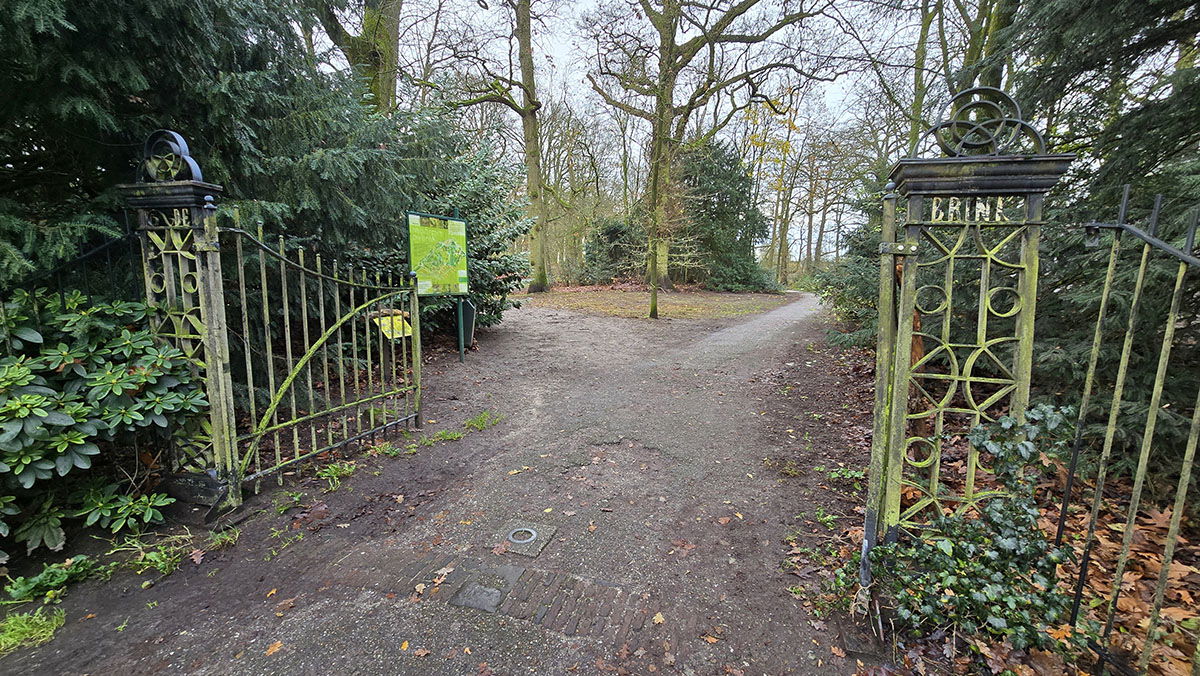
From Kroostweg, we walk along the asphalted path through the black and green-stained wrought-iron entrance gate into the publicly accessible country estate. The name of the estate is displayed on the gateposts in white-painted letters: “De” on the left and “Brink” on the right. The entrance gates on Utrechtseweg and Kroostweg are identical and date from the time the house was built. Here we enter an oasis of tranquility, with the former workers' cottages on the right, then the farmhouse, and on the left, through the trees across the serpentine pond, the house De Brink. Here stand trees over 100 years old, such as the yew, oak, red beech, and chestnut. It is delightful to walk here along meandering paths beneath old as well as newly planted oaks and beeches, right in the middle of our village. If you look closely around you and are lucky, you might spot a squirrel, buzzard, woodpecker, tawny owl, hedgehog, polecat, wood mouse, bat, or even a kingfisher here. About five years ago, I saw a buzzard that had fallen out of the nest stumbling along, with its parents diving towards us above. That was a goosebumps moment and quite terrifying.
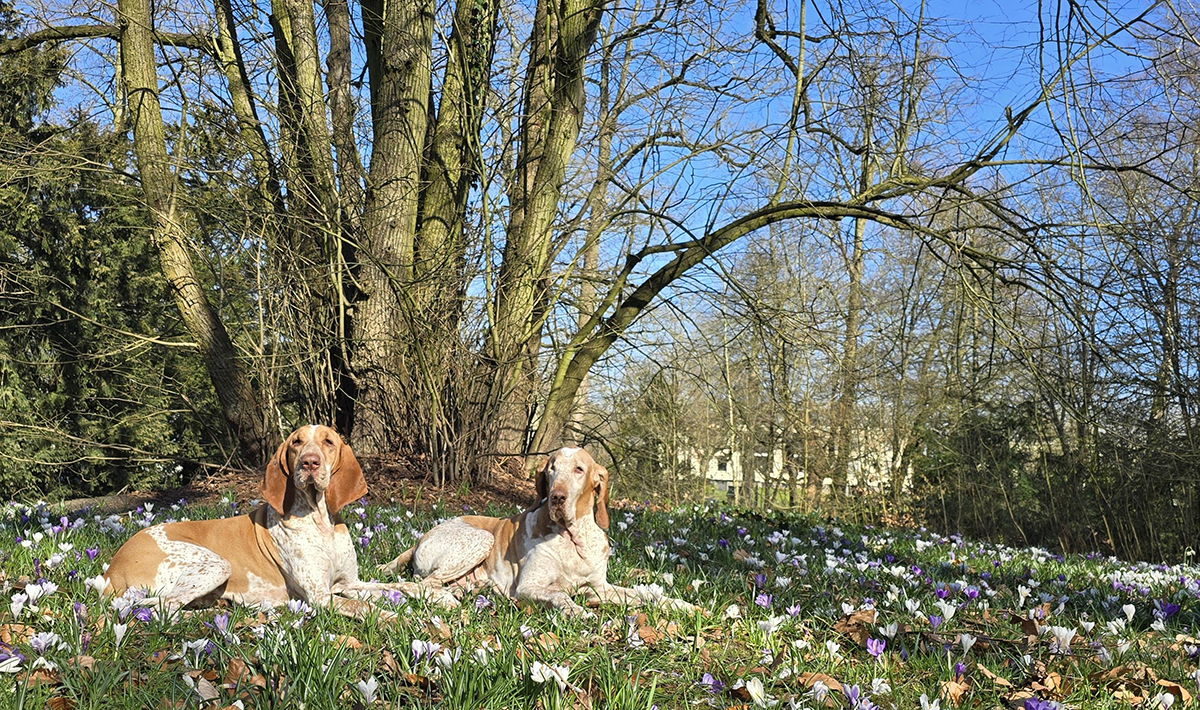
In front of the little bridge on the left, under the beech and oak trees, crocuses grow in the spring, and to avoid trampling any crocuses, I take a photo of Siena and Giulia as carefully as possible. They stay put nicely, because they know there is no escaping this photo opportunity. To the right of the little bridge lies a meadow where you can see horses, donkeys, cows, and sheep belonging to the petting zoo grazing. We turn right immediately after crossing the bridge, and here the serpentine pond flows via a culvert into a lower-lying, long, straight ditch. According to the garden map from 1922, this was an oak forest that extended all the way to where the De Brink residential area is now located.
On this same path, in 2021, my love and I found a pebble painted with a blue flower bearing the text “Forget me not,” with the text “keitof F #3703” on the back. The remarkable thing was that that same afternoon, I had picked up the ashes of our Bracco Italiano “Luna” from the vet; she had bled to death in just a few hours. Was this a final farewell from Luna? I had actually planned to walk through the village with Siena, Luna’s sister, for the evening stroll. But because my love really wanted to come along, though only to De Brink, I changed my mind, and we found this painted pebble, which we would not have found if we had walked through the village. This stone now lies in my small glass display case with special stones.
The path runs beneath mighty old beech and oak trees, and here and there you see wooden nest boxes hanging, including a few very large ones intended for the Tawny Owl. Upon reaching the end, you can cross via the small wooden bridge to the De Brink neighborhood or continue on to Nijenheim. The neighborhood is built on the former vegetable garden and meadows. We leave the bridge to our right and continue our way to the left, where the orchard used to be, with the vegetable garden on the other side of the water. The gardens of the houses on the opposite side are situated very idyllically by the water, with a deck here and there. Here, too, there are now tall beech and oak trees. To the left runs a path parallel to the one we walked along past the meadows, and in the distance at the end of the path, I see the lawn with the old oak tree and, behind it, the house called De Brink. The original formal garden lay in front of the lawn, with the house called De Brink opposite. The dogs are far from tired yet, so we continue walking along the outer footpath beside a fence behind which lie the sports fields and buildings of Bartiméus. The country estate's original stable and coach house are located a little further away, and upon arriving there, I see through a gate that the Bartiméus office is housed there. The building was completely renovated a few years ago, during which a lot of original details and old stable doors and windows disappeared, making it look like a brand-new building. You could have a worse workplace.
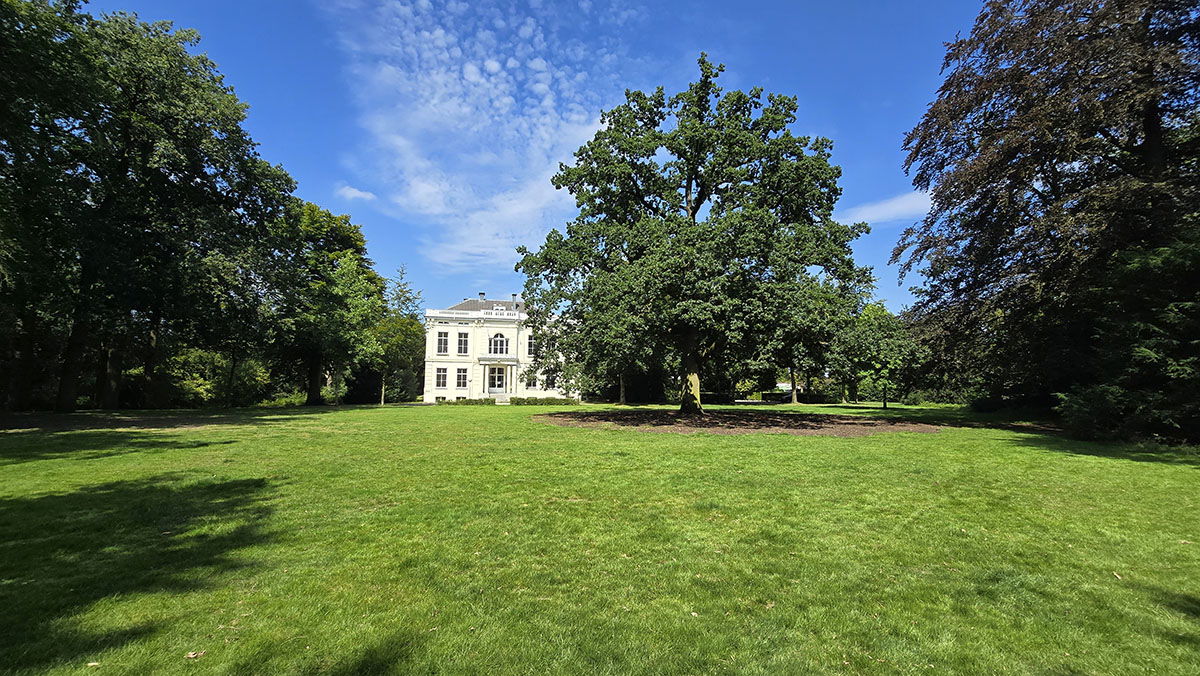
The originally formal garden lay in front of the lawn, with House De Brink opposite. The dogs are far from tired, so we continue walking along the outer footpath, past a fence behind which lie the sports fields and buildings of Bartiméus. The original stable and coach house of the country estate are located a little further on, and upon arriving there, I see through a gate that the Bartiméus office is housed there. The building was completely renovated a few years ago, during which a lot of original details and old stable doors and windows disappeared, making it look like it could easily be a new building. You could have a worse workplace.
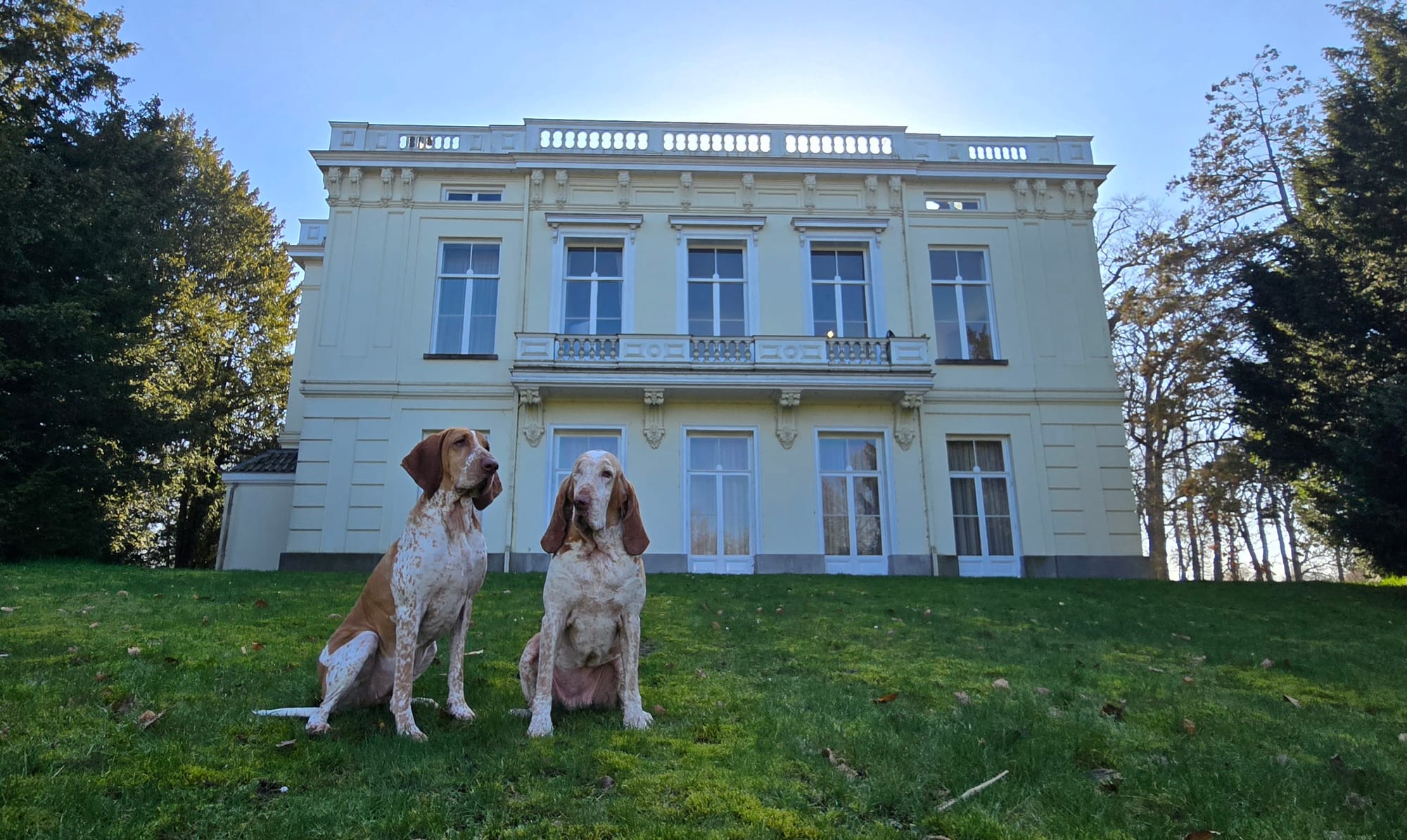
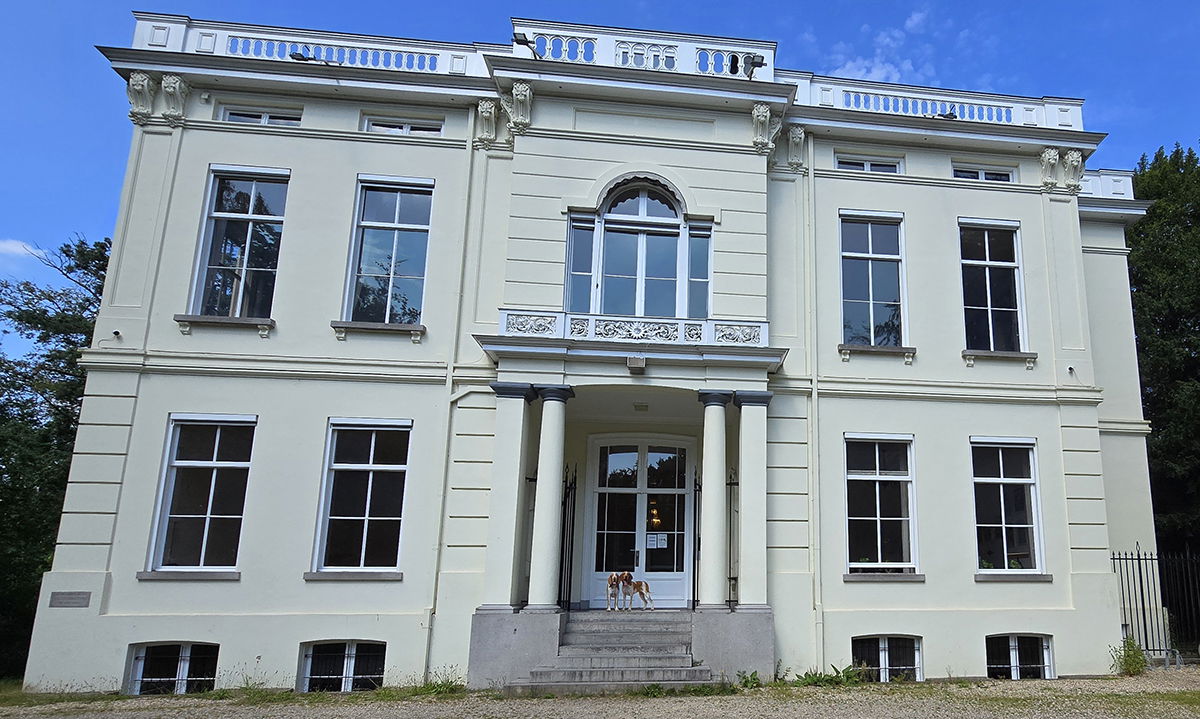
Damn, there comes a Buzzard flying not-so-high over me and lands on a branch to look at us. Would it still recognize me, and how big it is—brrr, goosebumps, and get out of here. We walk along a winding path past the parking spaces, via the left side, to the front of the house. As I do for every house, I take a photo of my beautiful Italian Bracchi Siena & Giulia sitting in front of the house and see admiring glances from passersby. How beautiful the house looks in the sun, and what wealth and luxury it must have been to have lived here like this in the past. The front of the house, with the ground floor at ground level, is angled towards the centuries-old village green and the opposite country estate, Schaerweijde. The unmarried Johanna Pols (1813-1900) lived here since 1854. In those days, the nobility liked to keep an eye on each other, but certainly on the unmarried ladies, and it is rumored that the young nobleman could thus see which gentlemen she was receiving as visitors. In 1867, the young lady had the old house demolished to build the current house, where she lived until 1875.
Siena and Giulia are happy that we are moving on and run after each other, romping across the lawn. I stand still for a while and enjoy this spectacle and the sun. We have to keep going, so I follow the path that leads to the beginning of the serpentine pond to walk up the footpath from there. Through the vegetation, I see the house lying on the other side of the water, and crossing the small bridge again, I arrive at the back of the house, which is now an office villa. On the far left corner, at ground level, I see the symbolic laying of the foundation stone bearing the name of the then one-year-old and eldest daughter, Catherine: “C.E.W. Huydecoper 24 May 1856”. This is the same type of stone as the one I found at the Wulperhorst: “Laid by Jan Elias Huydecoper, aged 8 years, 18 June 1858”.
The basement of the house extends underground all the way to the front facade and contains nine rooms, including the entrance, hall, toilet, corridor, and stairwell. This was the domain of the resident staff. There were, for instance, the governess, lady's maid, coachman, carpenter, head gardener and three garden workers, a farmer, and a stable boy. You will find many original features here, including a brick sink with copper taps and a hand pump, a built-in food lift that opens into the corridor, a wall of cupboards, a kitchen counter, and a fireplace. In front of the basement windows, which protrude halfway above the ground, there is a recess on the outside, also known as a cellar window. This allowed daylight to enter and provided ventilation. After all, electricity did not yet exist at that time.
Climbing seven steps of the stone staircase, I reach the landing with two round and two square pilaster columns on the left and right. In this porch, I am standing on the ground floor (piano nobile), at the same level as the lawn in front of the house where I took a photo of my dogs. The intercom displays “Villa de Brink 1856”, the names of about fifteen tenants, and Utrechtseweg 82. I feel the doorknob, but it is locked, and while taking photos, I peer inside through the glass door. The entrance has gleaming marble floors, a chandelier, and mirrored interior doors; it looks magnificent. On this ground floor, you find enormous rooms at the four corners, with the entrance, the hallway to the stairwell, kitchen, cloakroom, and toilet in the center. The house has a lot of original woodwork and remarkably well-preserved hinges and locks. The interior and layout appear to be largely authentic. You should take a look at the photo gallery. On the first floor, there are seven rooms and a bathroom with a separate toilet. The attic was a large open space with a room and was probably also the domain of the live-in staff.
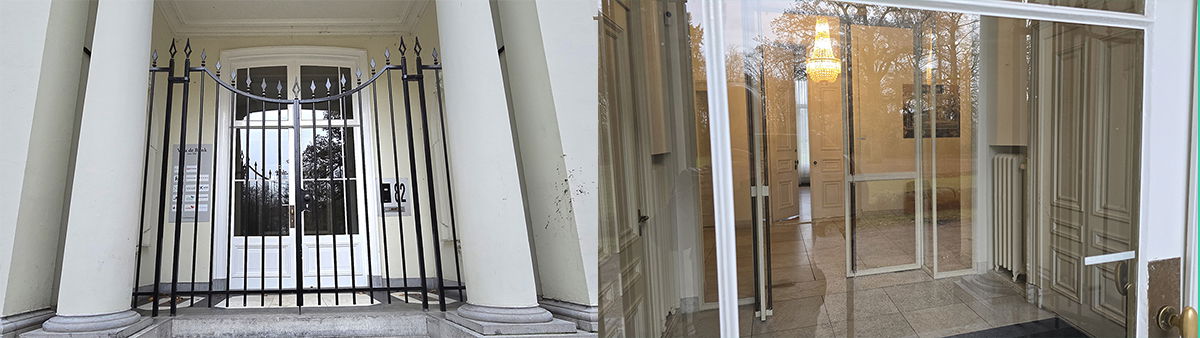
Due to vandalism, the entrance to the villa is closed off in the evenings and on weekends by means of an old-looking but new wrought-iron railing with sharp points. I also see four lamps hanging at the top of the roof edge that illuminate the villa when it is dark, making it less appealing to linger there. I do not see any cameras, but they are undoubtedly present. It is a pity that all this is necessary, but partly because the park is (fortunately) public, this monument has had to deal with a great deal of vandalism over the past fifty years.
On the lawn behind the house stands a mighty oak planted in 1856. A few years ago, a low chestnut wood fence was placed around this tree, featuring a carved text in an oak base asking park visitors to leave this living monument in peace. We, as well as other dog owners, respect that. Children and dogs must listen, and I therefore do not allow my dogs to walk on the other side of the fence.
Current owner
I ask one of the tenants standing outside smoking if I can take a look inside. No, the landlord does not allow this. He tells me that this property is owned by “Boron,” the family office and private investment company of the Fentener van Vlissingen family. Entrepreneur, billionaire, and philanthropist John Arthur Fentener van Vlissingen (1939-2025) passed away at the end of last year. John Arthur appeared on television in 2017 and 2018 in the program “Allemaal Familie.” The program focused on over 260,000 family businesses, in which family members have been running a company together for decades or even hundreds of years. You would see him driving away in a very substantial Mercedes from his investment company Boron at the beautiful “Ma Retraite” on the Utrechtseweg. There, too, I am not granted permission to take photos from the garden to support my story about Ma Retraite, and even the Gilde Zeist is denied access. When he was in the Netherlands, the old gentleman lived in “Huize Stoetwegen” on the Tiendweg, the house to the right of the entrance to the Wulperhorst. When I wrote my story about the Wulperhorst last year, I took photos of the entrance area next to which this house stands. Fifteen minutes later, I received a call on my mobile from the police asking why I was taking photos and that the family was getting very nervous about it. Understandable, because as a billionaire, you are a potential target.
I have now reached the end of the walk, and tired but satisfied, we walk along the driveway towards the entrance gate on Utrechtseweg, where unsuspecting traffic rushes past. Looking back and quickly taking a photo, I say arrivederci and see you soon.
On my site www.als-bomen-en-stenen-konden-praten.com you can read more about the origin of the name Huydecoper, the parents and the Huydecoper family living at Zeist Castle, the mayor, the construction of the country estate, and a brief overview of the owners and tenants. You can also find my previously published stories here.
How beautiful Zeist is, and how lucky we are to live here,
Arnie Della Rosa
Want to comment on a story? Include your name and email address with your comment so I can reply if necessary. Don't want to miss anything and want to receive an automatic notification when there is a new story? Send an email to avanr1956@gmail.com and I will add you to the mailing list.