Country Estate Ma Retraite “Huize Sint Jan”
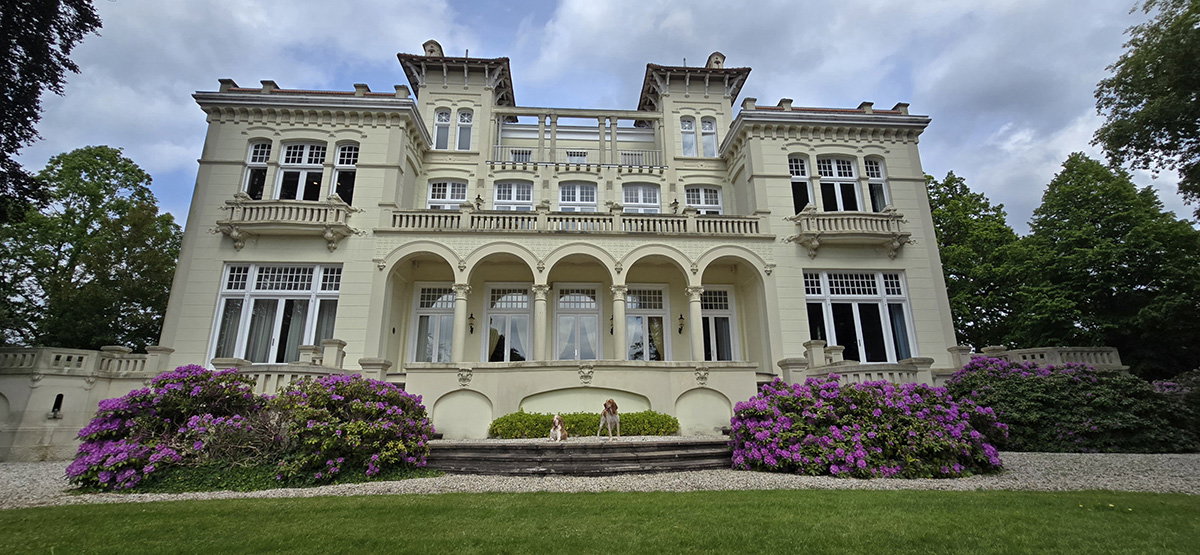
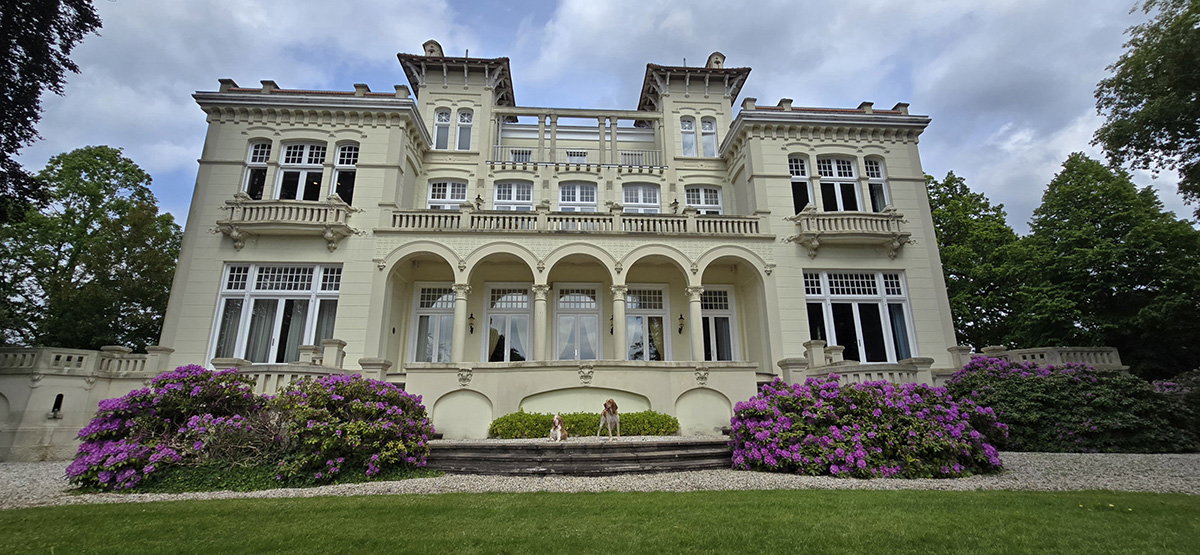
There on the Utrechtseweg, diagonally opposite the Science Park, the former TNO, lies the Italian palazzo-style Ma Retraite. How beautiful she is, and how time has treated her. These lyrics certainly apply to this magnificent house, which has always captured my imagination. Surely, everyone wishes to live here. The country estate has a rich history of founding, demolition and new construction, auction and sale, enlargement and subdivision, family boarding house and secret meetings, war and occupation; originally white and green during the war years; headquarters and hospital for the Canadian Liberation Army; boarding school and treatment center; fires and fire and army training center; saved from demolition; and since 1987 an office building that has risen from the ashes like a “phoenix.” Fortunately, the house has been preserved and is listed on the National Monuments Register with its facade, garden, and pond. My hope of entering this country estate, which is not accessible to the public, had already vanished, until I received a completely unexpected call from a friendly employee. She invited me to come and take photos of the exterior of the house and the garden. After all, an opening photo with Siena & Giulia on the terrace in front of Ma Retraite cannot be missing from my story series.
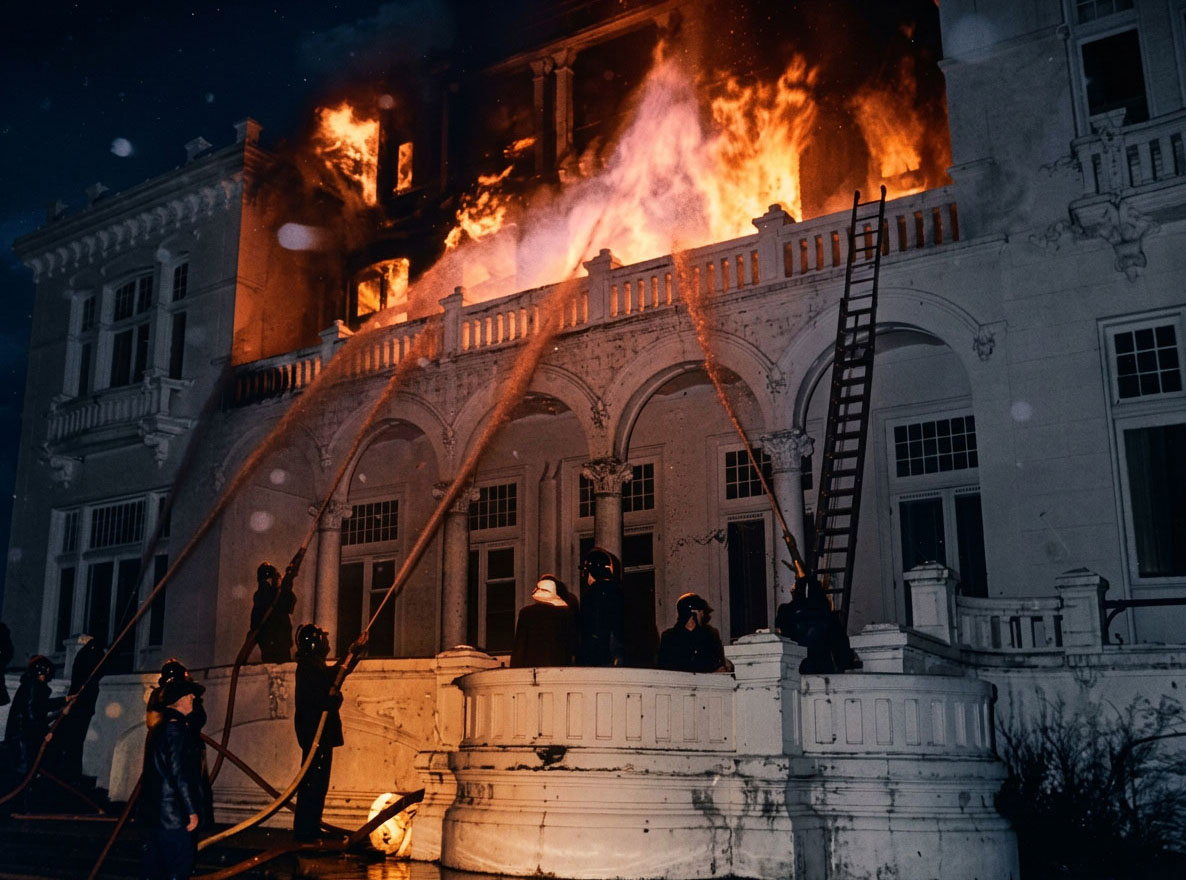
I remember the country estate and house from the time when it was known as “Huize St-Jan,” which was owned by the Foundation the Society of the Crusaders of St. John from 1946 to 1978. It was a lay community of brothers without religious monastic vows, but living according to the counsels of the Gospel. In this Orthopedagogical Therapeutic Center and boarding school, four groups of 12 boys, some of whom were very difficult to raise, aged 12 to 18, were treated. The boys lived not only in the house but also in the pavilions behind it and attended regular education elsewhere in Zeist and Utrecht. On January 19, 1976, the central section burned down. According to Hein, one of the boys I knew from dance lessons at Dansacademie Rettichini and who stayed at St.-Jan, one of them had been smoking in bed. But the rumor that one of them had started the fire was also circulating. According to reports from the police and fire department, however, the cause of the fire was unknown and could also have been caused by the severely outdated electrical wiring. The cause will therefore always remain a mystery, but the fire and the arson that followed the night were certainly spectacular.
The municipality and the Fentrop Foundation, with which the Crusaders of St. John had entered into a partnership, could not reach an agreement regarding new construction. In 1979, the land, plot, and buildings were sold to the联合 Dura companies from Rotterdam, who intended to demolish it and replace it with a modern building and residential development. Because the Municipality of Zeist did not agree to demolition and new construction, Dura proceeded with renovation in 1986 and received the European Heritage Award for it. The construction and sale of 34 private sector homes on Tesselschadelaan and on the rear site—now Guido Gezellelaan—made the renovation, costing over 2.5 million guilders, possible. And so, we can now enjoy the sight of this beautiful house with its garden and pond every day. Quanto è bella, or, How beautiful she is.
History of the country estate
Willebrordus Verkerk, an iron merchant from Utrecht by profession, purchased the former gallows field located on the north side of Zeist from the Provincial Administration in 1797. Through his heirs, the land came into the possession of Mr. Laurens Johannes Nepveu and his wife Margaretha Roosmale in 1816. Laurens was a member of the vroedschap, the executive board of Utrecht, and also a member of the Provincial States of Utrecht. The couple, who lived at Janskerkhof 15A, were also the owners of the Dijnselburg country estate, where they are interred in the family grave.
Macabre fact
From 1599 until their abolition in 1797, Zeist had two gallows, namely on the north side and the east side. The gallows of the Provincial Court of Utrecht (’t Hofsgericht) stood on the north side, approximately opposite Ma Retraite on the Oude Arnhemseweg on the “Zeyster Zand”, opposite the Sanatorium for the mentally ill and nervous patients opened by Queen Mother Emma in 1903. The gallows of the “High Lordship of Zeist” on the east side stood near the country estate ’t Kerckebosch, now Hotel Kasteel Kerckebosch. After the death sentence had been carried out on the criminal by beheading, hanging, strangling, or breaking on the wheel, the body was taken to the execution field and hanged again on the gallows or placed on a wheel. It was intended to serve as a deterrent example. The bodies of the criminals remained on display there until they had completely decomposed, after which the skeletons were buried underground near the gallows. In 1795, the custom of displaying executed criminals was abolished.
Origin of the name “Ma Retraite”
Laurens Nepveu had a simple summer house with a coach house built on the long, elongated 9-hectare plot between the Schapendrift (Sanatoriumlaan since 1910) and close to the Utrechtseweg. It ran parallel to a running path at the height of the current small island where you now see the weeping willow standing. The rear boundary of the country estate was formed by the Oude Arnhemseweg, which, as a dirt road, was part of the Cologne-Utrecht route. Laurens named the country estate, with its semi-oval garden, winding paths, and vegetable garden, “Ma Retraite,” after the coffee plantation in Suriname which he had inherited from his father. As Huguenots, his great-grandparents, Aubin Nepveu and Anne Baron, had fled from France to the Netherlands with their children in 1685. After their deaths, his grandparents, Louis Nepveu and Suzanne Hamelot, emigrated to Suriname in 1723, where Louis died four years later. Father Jean Nepveu was a notary in Suriname and entered the service of the colonial government in 1742. He held the position of Governor from 1768 until his death in 1779 and was also the owner of seven houses and eight plantations with a total of eleven hundred slaves. After his death, Laurens inherited an enormous fortune, including two of the eight coffee and cocoa plantations: La Singularité and Ma Retraite. Laurens did not manage the plantations, nor his own sugar plantation Appecappe, himself, but left this to a plantation director. Approximately 600 enslaved people worked on these three plantations under appalling conditions. The mortality rate of 2.8 percent was far above the then-prevailing average of 1.87 percent per year. The estimated fortune, consisting of the three plantations and his inheritance from his parents' estate, amounted to the unimaginable sum of nearly 900,000 guilders. The French words “ma retraite” literally mean “my refuge”. Because his French great-grandparents had fled to the Netherlands as Huguenots in 1685, it is highly probable that the name of the country estate, Ma Retraite, is a reference to the plantation where the family felt safe and from which they became wealthy.
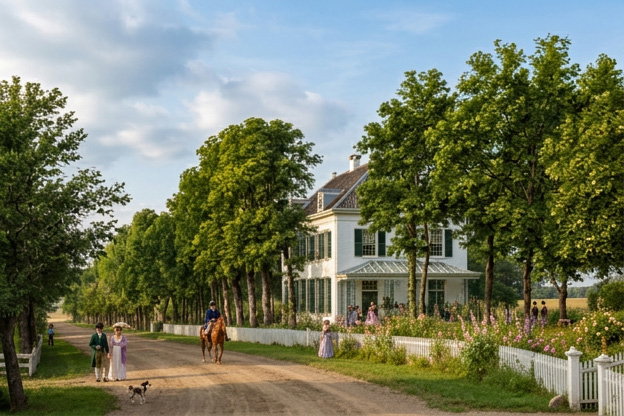
Colored lithograph from 1869 of “Ma Retraite”, Maker: Lithographer and painter Petrus Josephus Lutgers (1808-1874).
Newer and larger “Ma Retraite”
In 1832, lawyer and alderman (public administrator) of Utrecht, Mr. Cornelis Maria van Hengst, purchased the country estate. He substantially expanded his holdings with the purchase of the Zandenhoef and Konijnenbergh estates, situated on the Utrechtse Straatweg, owned by Hendrik van de Poll. After the Oude Arnhemseweg was relocated northwards, the three estates were merged. A new and larger country house appeared on the same site, situated within a landscape park with a winding pond laid out by Jan David Zocher Jr. After his death in 1848, the estate was inherited by the son of his brother Cypriaan Gerard, Carel Joseph van Hengst. He sold over 12 hectares of orchard, arable land, and woodland adjacent to Ma Retraite and on the north side of the Utrechtse Straatweg. The estate was then bordered on the right by the Veldheim estate, on the left by the Sanatoriumlaan, at the front by the Utrechtseweg with an adjacent plot, and at the rear by the Oude Arnhemseweg. Twenty-six years later, in 1858, the country estate, then still 14 hectares in size, including the adjacent property on the other side of the Utrechtseweg, was sold to the tobacco broker, Justus de Mol van Otterloo.
Auction and Sale
The country estate was put up for auction several times. The first time was in 1881 in Amsterdam, in fourteen different lots. The estate was described as follows: “A spacious manor house, coach house with stables for 7 horses, coachman’s lodge, gardener’s lodge with cowsheds, orangery, greenhouses, dome, barns, and other timber structures. Furthermore, grounds for recreation, a water feature, vegetable and garden land with the gracefully laid-out estate opposite, divided into pasture, vegetable garden, hill, and water.” The entire property fetched f 102,425. The largest part, comprising over 11 hectares—of which more than 2 hectares is the estate—was purchased, including the house, for f 70,325 guilders by Joan Maria Baron van Voorst tot Voorst, director of the Overijssel Fire Insurance Company in Zwolle. Because the municipal council decided to widen the Utrechtseweg, the house had to be demolished, whereupon the Baron decided to offer the estate for auction.
During this second auction in 1896, Johannes Hendrikus (Jan) van Marwijk Kooy acquired the house, including the surrounding plot, for 72,000 guilders. His wife, Jeanne Henriëtte, was the daughter of J.B. Beuker, a sugar refiner in Amsterdam, who lived at Zandbergen in Huis ter Heide. Together with his brother-in-law Charles Antoine de Pesters and Willem Eduard Uhlenbroek, Van Marwijk Kooy was a founder of the Bavarian Brewery De Amstel in Amsterdam and served as its director. Charles de Pester lived with his wife Petronella van Marwijk Kooy at the Nuova country estate on the Utrechtseweg, diagonally opposite Ma Retraite.
Demolition and new construction
Van Marwijk Kooy had the old seventeen-room house demolished, and architect Abraham Salm from Amsterdam was commissioned to design a new house, including the interior, garden, and gatekeeper's lodge. The design of the English landscape park and the rear grounds was created by the Haarlem landscape architect Leonard Anthony Springer.
Sketch designs Ma Retraite and Villa Borghese Rome.
During excavation work for the water features, an iron chain approximately 8 meters long and pieces of beams with heavy nails came to light, and skeletons were encountered. This indicated that it was quite possible that the gallows of the Provincial Court of Utrecht (’t Hofsgericht) were located in the vicinity of Ma Retraite. The more than 10,000 m³ of soil that was excavated was used to create two hills and raise the terrain for the house to be built. Two small islands were constructed in the widened pond in front of the house, with a concrete grotto in the extension on the side of the Veldheim country estate serving as an ice cellar. Game shot in the Pan hunting grounds belonging to Ma Retraite was stored far from the house in an ice cellar at the end of the winding pond on the side of Sanatoriumlaan. The winding pond, in which swans swam, ran under the Utrechtse Straatweg to the adjacent estate with pasture land. To operate the fountain in the pond, an 11-meter-high water tower stood near the coach house on Sanatoriumlaan from 1902 onwards.
Completion
In late 1898, Salm completed the country estate with the snow-white, palazzo-style house. However, the people of Zeist did not understand what “Ma Retraite” meant, causing the house to soon acquire nicknames such as “cream cake” and “meringue cake” due to its striking white color and rich ornamentation.
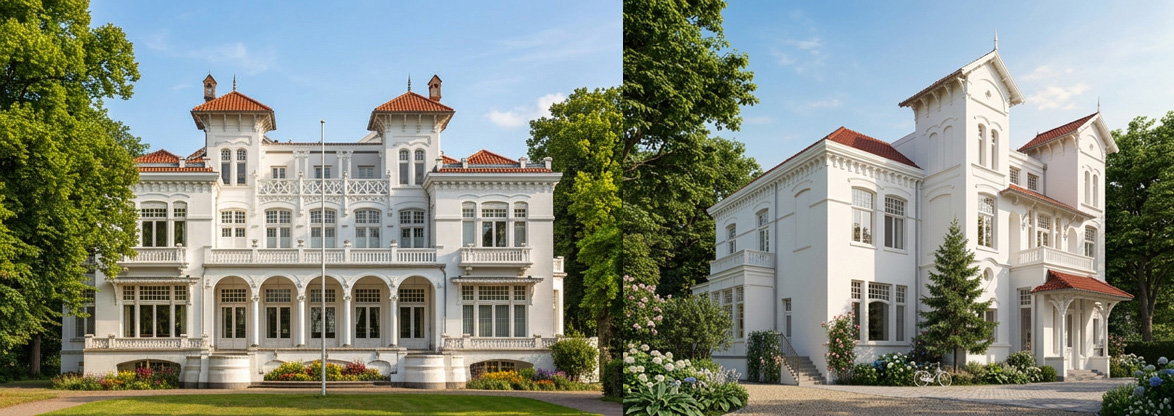
The house could only be reached by the family and their visitors via a paved road from the main entrance on the Utrechtseweg. On the roof of the gatekeeper's lodge with a stair tower stood a bell frame containing a bell. By ringing the bell, the gatekeeper could alert the staff that the family or visitors were approaching. The gatekeeper's lodge was demolished in 1960, but the stair tower, converted into a dovecote, has been preserved and is now a municipal monument. To the left of the tower stands the Renaissance gate from 1633, a remnant of the demolished Ridderhofstad Kersbergen, which was replaced by the house Kersbergen, demolished in 1934. The person who demolished the house, Mr. Zijlstra, placed it in the garden of his own home. The ground floor and the first floor of the house were the domain of the family. From the vestibule, you entered the hall with the main staircase to the upper floors and a cloakroom with sanitary facilities, a large drawing room, a small drawing room opening onto the terrace, a dining room, a conservatory, a men's room with a hidden door behind which a staircase led to the basement with a safe, a billiard room, and a service room with a dining lift. On the first floor were 4 bedrooms, a dressing room and sitting room, a bathroom, a wardrobe, a linen room, and three guest rooms.
Gatekeeper’s lodge.
Staff present invisibly
The staff as well as the suppliers used the entrance on Sanatoriumlaan located next to the coach house, from where a road with a bridge over the winding pond led to the house. The staff, who at that time were required to remain invisible, used a separate service staircase inside the house to the basement, first floor, and attic. The basement housed the kitchen with a food lift opening into the service room, the utility room, an external entrance for staff and suppliers, an ironing room, a polishing room, a safe, a servant's quarters, a heating unit, a coal room, a pantry, a wine cellar, a linen room, a storage room, and a toilet. The servants, butler, and lady's maid lived in the attic, where the servant's quarters with two bedrooms, a linen drying room, a sewing studio, and a water reservoir were located. The other staff members lived in approximately fourteen service quarters, a porter's lodge, a gardener's cottage, a gamekeeper's lodge, a coach house, and a farm. Furthermore, a playhouse, an orangery, a sunken rose garden, a vegetable garden, and greenhouses could be found on the estate. At Sanatoriumlaan 25-31, a block of four service houses still stands, in one of which—you can hardly believe it—the family of gardener Koetsier, consisting of eight people, lived. At Oude Arnhemseweg 307, the white gardener's house of head gardener Polder also still stands. Across the street lay the farm belonging to the country estate, owned by farmer Geytenbeek, with pastures and fields extending to the present-day Joost van de Vondellaan.
Coach house, gardener's house and four service houses.
Subdivision
Following the death of widow Jeanne Henriette van Marwijk Kooy-Beuker in 1930, the staff was sent home with a pension allowance of 10 guilders per week, and negotiations began with the municipality regarding the subdivision of the country estate. In 1932, the municipality reached an agreement with Jhr. Pierre Herbert Bicker, widower of daughter Elisabeth (Élise) van Marwijk Kooy, that the heirs would cede a piece of land from the estate free of charge for the widening of the Utrechtseweg. The construction costs of the new road, Harmonielaan, amounting to 22,000 guilders, were borne by the heirs. The Koppelweg became Oirschotlaan, and in exchange for all this, the family received permission to sell the estate of over 2 hectares for the construction of villas. In remembrance of the estate, the house at Utrechtseweg 48a features the original entrance gates of the country estate bearing the name “Klein Ma Retraite”. The pond of this house and the winding pond of Ma Retraite are still connected as they run under the Utrechtseweg. The area along the Sanatoriumlaan, which formed the western boundary of the country estate, and the northern part of the park, where the orangery and the gardener's house stood, were also sold successively. But first, the heirs were required to deposit 15,000 guilders into the municipal treasury as a share in the construction costs of the Tesselschadelaan, P.C. Hooftlaan, Roemer Visscherlaan, and Da Costalaan. Consequently, Ma Retraite was already enclosed on three sides before the war, and more than half of it had been cut in half.
The house is rented out on behalf of the heirs as a first-class family guesthouse with 26 rooms and central heating. Until 1937, it was run by former gardener Dirk Dros and his wife, and from that year onwards, by Anna de Roode as manager. During the mobilization, Lieutenant General of Infantry Jan Joseph Godfried, Baron van Voorst tot Voorst, requisitioned several rooms on behalf of the Dutch armed forces. In the utmost secrecy, the General Staff and Prince Bernhard met there to discuss the threat of war from Germany and the possible flight of the Royal House. Was this a coincidence, or did he know Ma Retraite as the house of his uncle Joan Marie Baron Voorst tot Voorst, who was the owner from 1881 to 1896? Mayor Willem Adriaan Johan Visser and his wife, Jkvr. Jenny Micheline de Geer, rented a number of rooms there for several years. So too was Harry Antoon Jozef Dreesmann, director of Vroom and Dreesmann N.V. Utrecht, Amersfoort, and Dordrecht, with his wife Geertruida Paulina Antonia Maria “Tuut” Peek. The German occupiers requisitioned the house in 1942 and painted the white villa green to camouflage it against Allied air raids. After the liberation, the house served as headquarters and a hospital for the Canadians for another year. On the small island in front of the house stands a weeping willow planted there in memory of the liberation. In 1946, the country estate was sold to the Society “the Crusaders of St. John”. After the necessary renovations, they opened the Orthopedagogical Therapeutic Center and boarding school as Huize St.-Jan. And so we are back at the beginning of this story, and I hope to have introduced more people from Zeist to the history of this beautiful house.
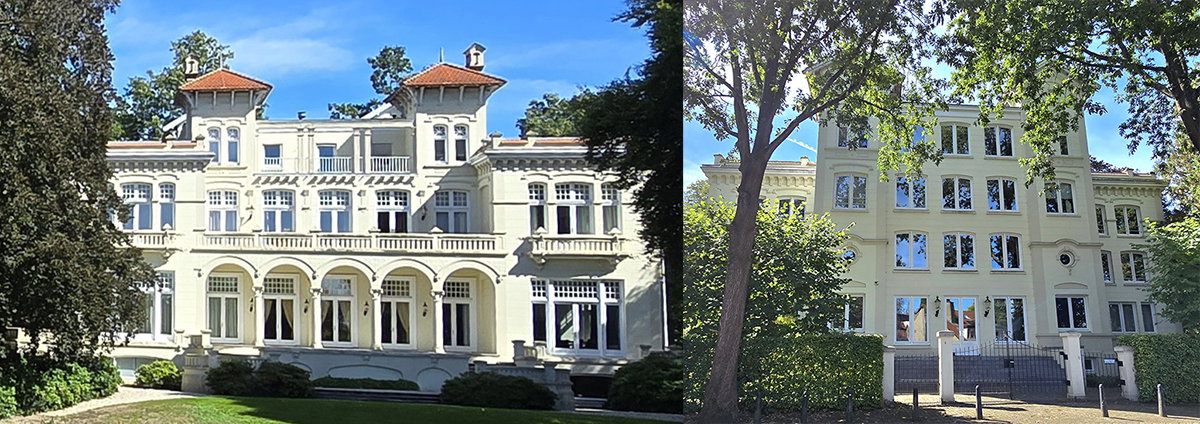
Ma Retraite in 2026
Almost nothing remains of the original English landscape park, spanning over 12 hectares. The decimated country estate and house have served as an office building since 1988 and are now registered in the name of Boron Estates Holding B.V., the family office and private investment company of the J.A. Fentener van Vlissingen family. Boron also supports meaningful foundations established by family members across various generations. Entrepreneur, billionaire, and philanthropist John Arthur Fentener van Vlissingen passed away at the age of 86 in late 2025. John Arthur appeared on television in the 2017-2018 season in the program “Allemaal Familie”. The program focused on over 260,000 family businesses, in which family members have been running a company together for decades or even hundreds of years. You would see him driving away from the beautiful “Ma Retraite” in a very substantial Mercedes. Although I was not granted permission to take photos from the garden to support my story about Ma Retraite, I hope to use this story to introduce more Zeist residents to the history of this beautiful house.
In the concise overview on www.als-bomen-en-stenen-konden-praten.com, detailed information on owners, residents, and usage from 1797 to the present can be found, with historical and new images of the interior and exterior of the house in the photo gallery.
Zeist is so beautiful, and how lucky we are to live here,
Arnie Della Rosa
Want to respond to a story? Include your name and email address with your comment so I can reply if necessary. Don't want to miss anything and want to receive an automatic notification when a new story is published? Send an email to avanr1956@gmail.com and I will add you to the mailinglist.