Brief overview of Castle Zeist
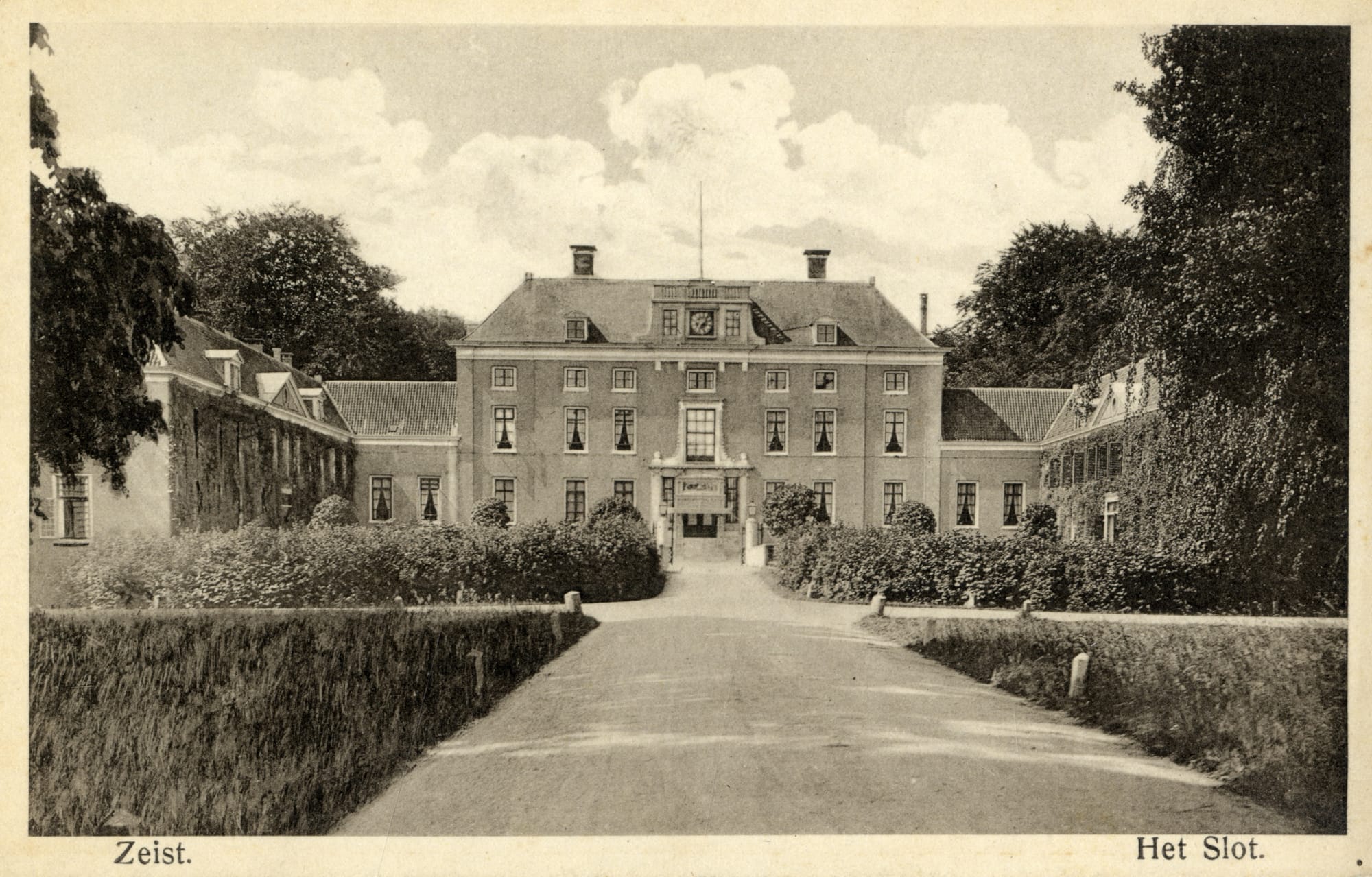
Addres: Zinzendorflaan 1
The oldest mention of Seyst dates from 1165
The land on which the castle was built was mentioned in 1165 as the property of a certain Godefridus van Seyst, without mention of a house. In 1536, mention is made of construction when "dat huys te Seyst, vry eigen goed" is recognized by the States of Utrecht as a knight's manor.
A knight's manor is land on which the house and associated buildings of a knightly man are located.
1677-1686
Construction of Zeist Castle as a pleasure garden for Willem Adriaan van Nassau (1632-1705), Lord of Odijk, Kortgene, Zeist and Driebergen, married to Elisabeth van der Nisse (1639-1698), Lady of Heinkenszand, Overzand and Driewegen
- Willem Adriaan was, through his father Lodewijk van Nassau-Beverweerd (1602-1665), grandson of Prince Maurits van Oranje (1567-1625), great-grandson of “The Father of the Fatherland” Willem van Oranje (1533-1584)
- purchase of the lordship of Zeist and the dilapidated medieval castle for 5,000 guilders from the States of Utrecht and Willem Adriaan therefore became Lord of Zeist
- design by Leiden city architect Jacobus Roman (1640-1716)
- interior design mainly by French Huguenot Daniel Marot (1661-1752)
- the largely preserved wall and ceiling paintings are reminiscent of the French Baroque
1705
- son Lodewijk Adriaan count of Nassau (1670-1742) lord of Odijk, Blikkenburg and Kortgene and grandson Willem Adriaan II (1704-1759) count of Nassau lord of Zeist and Driebergen, lord of Bergen
1745
- Cornelis Schellinger (1711-1778), an Amsterdam ironmonger, buys the Castle for 157,000 guilders for the Moravians who establish “Ortsgemeine” here. Schellinger thus became the baron of Zeist and Driebergen
- Cornelis Schellinger came to a financial agreement with Count Nicholaas Ludwig von Zinzendorf-Pottendorf (1700-1760), founder of the Moravian Church, that the latter would be given a wing of the Castle and the meadows in front of it. The houses of the Moravian Church would later be built on this. To the right of the driveway, space was made for the unmarried sisters and widows (the Sister House and the Widow House), on the other side for the unmarried brothers (the Brother House). Later, these were called the Sister Square and Brother Square respectively. Because the brothers and sisters had to provide for themselves, they founded various businesses such as a bakery, a button factory, a silversmith's and a tinsmith's. Their products were sold in the Broederhuis. In fact, this created the first department store in the Netherlands in Zeist.
1767
- Maria Agnes Zu von Dohna (born von Zinzendorf-Pottendorf) (1735-1784), free lady of Zeist married to Count Moritz Wilhelm Heinrich Zu Dohna-Schlodien (1737-1777)
- Maria never lived here
- Cornelis Schellinger moved after the sale of the Castle to Broederplein 25-29 (Schellingerhuis) and is buried on the Godsakker behind the Zusterplein.
1784
- Johannes Renatus (Jan) van Laer (1731-1792) lord of Zeist married to his cousin Cornelia Johanna Verbeek (1736-1804)
- member of the Moravian Church, rented out the Castle but continued to live on the Zusterplein
1792
- Johannes van Laer (1775-1816) last lord of the castle of Zeist married to Charlotte Beuning
1816
- Cornelis Renatus van Laer (1767-1842) married to Anna Cecilia van Laer (1770-??)
- Jacob van Laer (1769-1824) married to Anna Cornelia Lugt (1739-1799), Christiane Salomé Verbeek (1742-1798) ) and Anna Johanna van Laer (1739-1799)
1818
- sale to Coenraad Willem Wijborgh (1772-1844) married to Johanna Sonmans Boreel de Mauregnault (1775-1818)
- direct resale to Evangelical Lutheran Community in Berbice in British Guyana
- Castle and the squares are separated
- until 1830 the Castle was regularly rented out
1830
- Jonkheer Jan Elias Huydecoper van Maarsseveen (1798-1865) married to Maria Isabella Anne Josine Charlotte baroness Taets (1798-1865)
- restoration of the Castle in the Empire style (imperial style from the time of Louis Napoleon)
- application of Biblical images in the Willemszaal by the Dutch painter Cornelis Kruseman (1797-1857)
- development of the back garden into a landscape park by Jan David Zocher (1791-1870)
1867
- Henriëtte Maria Jacoba Labouchère-Voombergh (1830-1904) married to Charles Bernhard Labouchère (1817-1897)
- ceiling paintings in the Willemszaal were removed
1908
- Mr. Ernest Samuel Labouchère (1856-1932) married to Marie Adelaïde Mathilde van Weede (1860-1934)
- Henriëtte Constance Adèle Labouchère (1860-1935) married to Jonkheer Frank Karel van Lennep (1865-1928) lived in part of the main building and the left wing.
1924
- N.V. Bouw- en Exploitatiemaatschappij Heemstede in Utrecht buys the Castle for demolition
1924
- the municipality of Zeist buys the Castle six weeks later for 130,000 guilders with the park and the strip of forest between the 'extended' Koelaan and Waterigeweg
1925
- accommodation for various committees and municipal offices
1940
- requisition of the castle by Gutsche, Major der Deutschen Wehrmacht to establish the Ortskommandantur
- due to negligence of German soldiers, the castle was ravaged by fire in the night of 8 to 9 February 1945, the left wing burned down almost completely
1945
- after the liberation the castle served as a prison for political prisoners
- later the Entertainment Committee for the Canadian troops and the Intendance for Overseas Territories moved into the building
1948
- in the park, as part of a project for the unemployed, an open-air theatre was built with seating for 1000 people
1953
- the Castle was set up to accommodate victims of the Zeeland flood disaster
1957
- on 7 January the starting signal was given for the extensive restoration under the leadership of architect Johannes Bernardus baron van Asbeck (1911-2010), with the furnishing and decoration carried out by Jan Ruys
1960
- renovation of the castle to the original baroque style, using authentic demolition material from other baroque buildings.
1969
- completion of the restoration of the side wings
- reopening on 8 October by H.R.H. Prince Claus (1926-2002)
Claus George Willem Otto Frederik Geert, Prince of the Netherlands, esquire of Amsberg born as Klaus-Georg Wilhelm Otto Friedrich Gerd von Amsberg
2006
- start of 1-year renovation
- the invisible installation of installations and replacement of existing parts
- the visible results are the historical colour schemes of the wall paintings, the interior painting and work on the antique furniture
No expense or effort was spared for this extensive restoration. For example, the wall covering in the blue hall was re-produced on a seventeenth-century loom of this exceptional size. Based on the original designs, the aim was to restore the Castle to its original state as much as possible with great craftsmanship, but at the same time the necessary changes were made to meet the technical requirements of this time.